I’ve been analyzing how AI search models process user queries, and the mechanics reveal fundamental shifts in content discovery.
Today, nearly 60% of U.S. users rely on AI-generated answers without visiting traditional websites, according to SparkToro’s 2024 zero-click study. Over 100 million people use ChatGPT weekly, while Google’s AI Overviews appear in 13% of all searches. These platforms don’t just match keywords, they decompose queries into multiple sub-intents through a process called Query Fan Out.
What I’ve discovered: Your content isn’t competing for one search result anymore. It’s being evaluated against dozens of micro-queries generated from a single user prompt. LLMs break down requests, explore multiple angles, and synthesize answers from various sources simultaneously.
This changes everything about content strategy. If your content doesn’t match at least one fan-out angle, you’re invisible in AI-generated responses, regardless of your Google rankings.
Query Fan-Out represents a fundamental shift in Generative Engine Optimization (GEO) strategy. In this analysis, I’ll explain how Query Fan Out works, why it matters for visibility, and how to optimize content for multi-intent AI search behavior.
TL;DR
This patent describes a sophisticated system for automatically generating query variants using trained generative models (neural networks). “Query Fan Out” refers to the strategic expansion of a single user query into multiple related variants that are then submitted to search systems to retrieve a broader, more comprehensive set of results.
1. What is Query Fan Out?
Core Definition
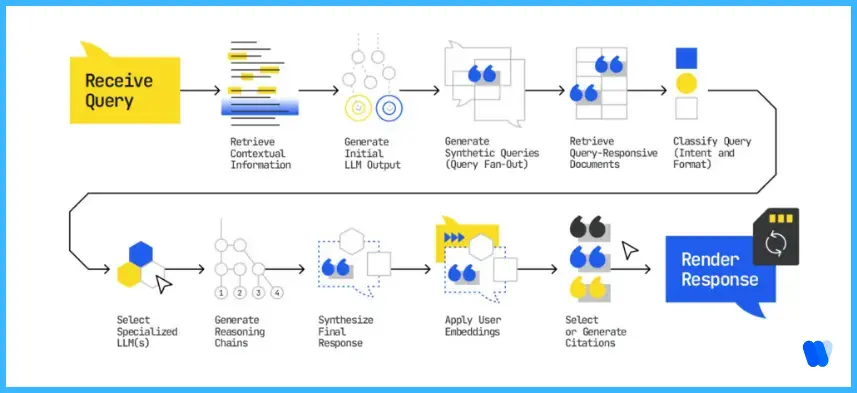
Query Fan Out is the process of taking an original search query and systematically generating multiple alternative formulations (variants) that preserve the user’s intent while exploring different linguistic expressions, specificity levels, and semantic angles.
The Mechanism
The patent describes a multi-component system:
- Variant Engine (112): Uses trained generative models to produce query variants
- Controller Engine (114): Determines whether variants should be generated and controls the generation process using reinforcement learning
- Search System (140): Executes searches for both original queries and variants
- Response Synthesis: Aggregates and presents results from multiple query variations
Technical Implementation
The generative models are typically sequence-to-sequence neural networks with encoder-decoder architectures (including LSTM and GRU units). They’re trained on large datasets of query pairs and user interactions to learn:
- Equivalent query formulations
- Follow-up query patterns
- Generalization and specialization relationships
- Canonicalization (converting queries to standard forms)
- Language translation
- Entailment relationships (queries that logically imply others)
2. Framework: The Query Fan Out Model
A. The Generation Taxonomy
The patent identifies multiple types of query variants:
Variant Type Framework
| Variant Type | Purpose | Example |
|---|---|---|
| Equivalent Query | Same intent, different wording | “funny cat pictures” → “humorous feline images” |
| Follow-up Query | Natural continuation of search | “Mona Lisa” → “Who commissioned Da Vinci to paint the Mona Lisa” |
| Generalization | Broader scope | “iPhone 13 specs” → “smartphone specifications” |
| Canonicalization | Standard form | “did da vinci paint the mona lisa” → “Did Leonardo Da Vinci paint the Mona Lisa” |
| Language Translation | Cross-lingual search | “Paris weather” → “météo Paris” |
| Entailment Query | Logically implied searches | “vegetarian restaurants” → “restaurants” |
| Specification Query | Narrower focus | “European history” → “French Revolution history” |
| Clarification Query | Disambiguation | “apple” → “apple fruit” vs “Apple company” |
B. The Control Framework
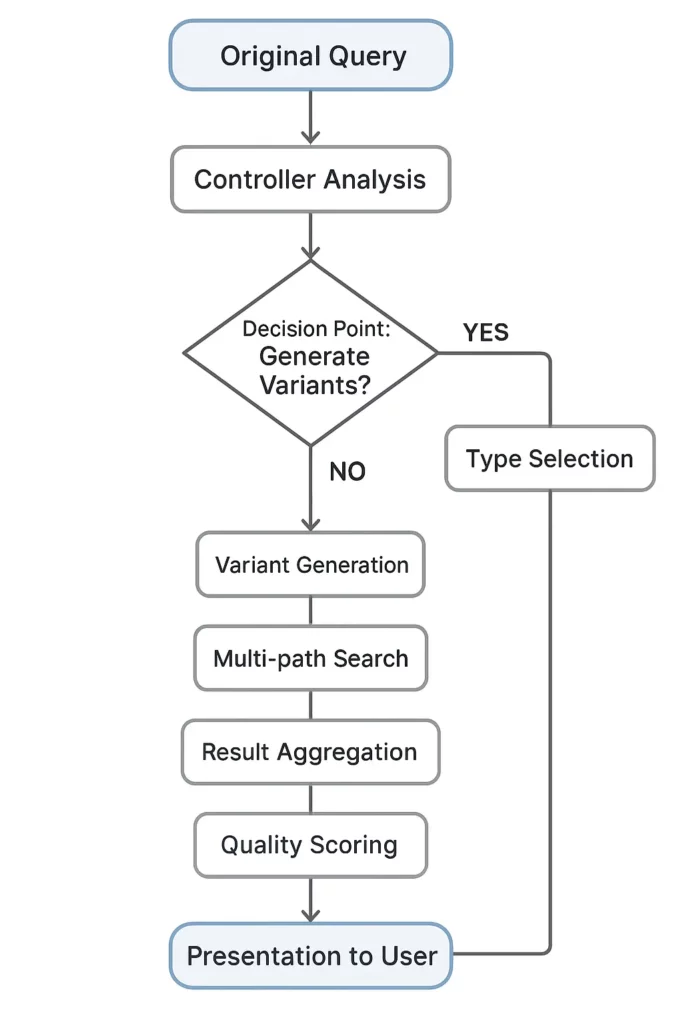
The Controller Engine uses reinforcement learning to decide:
- Whether to generate variants (based on query quality, ambiguity, expected utility)
- How many variants to generate (resource optimization)
- Which types of variants to prioritize (based on current state, user attributes, search system feedback)
This creates a dynamic decision tree:
C. Training Architecture
The system employs a multitask learning approach:
- Single training instances contain: original query + attributes + type indicator + expected variant
- Multiple generative models can be trained for different user segments or query domains
- Reinforcement learning trains the controller based on:
- Search result quality scores
- User engagement signals (clicks, dwell time)
- System efficiency metrics
3. Key Insights & Patterns
The system doesn’t generate variants in isolation. It considers: The patent describes chained variant generation where: Google may deploy: The system includes multiple quality gates:Pattern 1: Context-Aware Generation
Pattern 2: Iterative Refinement
Pattern 3: Multi-Model Strategy
Pattern 4: Quality Control Mechanisms
4. How Google May Use Query Fan Out
Current Applications (Inferred)
Google likely implements this as:System Architecture (Hypothesized)
5. SEO Implications & Strategic Adaptations
For Content Creators
- Over-optimization for Single Keywords
- Ignoring User Context
- Semantic Comprehensiveness
- Answer Multiple Query Formulations
- Capture Follow-up Intent
- Optimize for Query Relationships
For SEO Strategists Framework
1. Query Variant Mapping
Core Topic → Identify Query Types
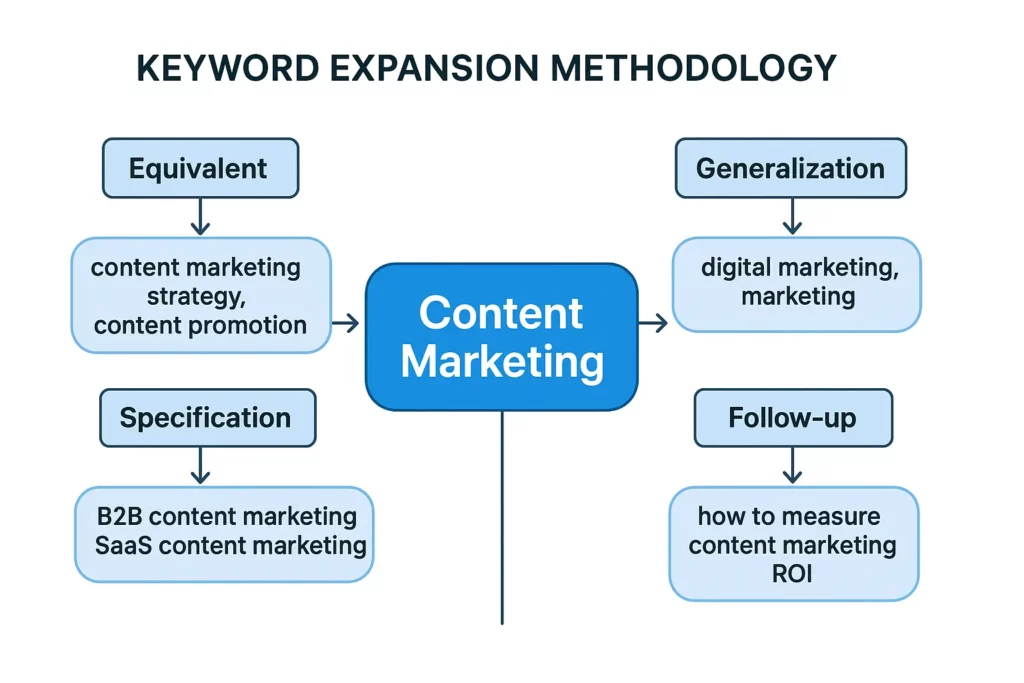
Example: “Content Marketing”
- Equivalent: “content marketing strategy,” “content promotion”
- Generalization: “digital marketing,” “marketing”
- Specification: “B2B content marketing,” “SaaS content marketing”
- Follow-up: “how to measure content marketing ROI”
- Clarification: “content marketing vs. copywriting”
2. Content Architecture
- Design site structure around query variant clusters
- Create hub pages for generalized queries
- Build spoke pages for specification variants
- Ensure internal linking reflects query relationships
3. Keyword Research Evolution
- Move beyond search volume metrics
- Analyze query relationship graphs
- Identify entailment chains (specific → general)
- Map follow-up query patterns from “People Also Ask”
Technical SEO Considerations
1. Structured Data
- Implement FAQ schema for variant questions
- Use HowTo schema for process-oriented content
- Leverage Article schema with multiple sections addressing variants
2. On-Page Optimization
- Use heading structures (H2, H3) that mirror query variants
- Create natural anchor text that reflects semantic relationships
- Optimize for entity recognition (proper nouns, concepts, relationships)
3. Content Freshness
- Regularly update content to address new query variants
- Monitor “People Also Ask” changes over time
- Track emerging related searches
For Marketers
Implications for Search Behavior
1. Longer Search Sessions
Users may see more comprehensive results from a single query.
- Expectation: “one search should answer multiple related questions”
- Opportunity: Capture attention across multiple query variants with comprehensive content
2.Reduced Need for Query Refinement
Google anticipates and serves variants automatically; users may not manually type follow-up queries.
Implication: Your content must appear in the first set of results to capture intent
3.Personalization Amplification
Variants are generated based on user attributes. Same query → different variants → different results for different users.
- Challenge: Universal SEO tactics become less effective
- Solution: Create content with broad appeal across user segments
Content Strategy Adaptations
1.Topic Cluster Model 2.0
Traditional: Pillar Page + Supporting Articles
Query Fan Out Era:
- Central Hub (addresses generalized query)
- Satellite Content (addresses specification variants)
- Cross-linking (reflects entailment relationships)
- FAQ Integration (captures follow-up variants)
- Multi-format (text, video, images for different user contexts)
2. User Journey Mapping Through Variants
Map content to query variant progressions:
- Awareness: “what is machine learning” (generalization)
- Consideration: “machine learning applications” (specification)
- Decision: “best machine learning course” (specification + attribute)
3. Competitive Analysis Shift
Don’t just track who ranks for your target keyword
- Analyze who dominates the variant cluster
- Identify gaps in variant coverage by competitors
6. Advanced Considerations
The Reinforcement Learning Wildcard
The Controller Engine’s use of reinforcement learning means:
- The system continuously learns from user behavior
- Variant generation strategies evolve over time
- What worked yesterday may not work tomorrow
Implication: SEO becomes more dynamic; continuous optimization is essential.
The Multitask Model Challenge
Multiple generative models exist for different:
- User segments
- Query domains
- Tasks (shopping, research, navigation)
This means:
- No single optimization strategy fits all
- Content must appeal across multiple user contexts
- Technical SEO must account for diverse ranking signals
The Personalization Problem
Variants are generated based on:
- User location
- Current task
- Temporal attributes
- Historical behavior
This creates:
- Less predictable SERPs
- Harder to track rankings (which variant was used?)
- Need for segment-specific strategies
Conclusion: The Query Fan Out Mindset
The most important takeaway from this patent is a fundamental shift in how we should think about search optimization:
Old Model: Keyword → Page
- Find a keyword
- Create a page
- Optimize for that keyword
- Hope to rank
New Model: Intent Cluster → Content Ecosystem
- Identify core user intent
- Map all query variant expressions of that intent
- Create comprehensive content addressing the entire cluster
- Structure content to reflect semantic relationships
- Continuously adapt as variant patterns evolve
Key Takeaway
Query Fan Out represents Google’s attempt to read users’ minds — to anticipate not just what they asked, but what they meant, what they’ll ask next, and what related information they need.
The winning SEO strategy is no longer about matching keywords. It’s about becoming the comprehensive answer to an entire universe of related questions — before the user even knows they want to ask them.
FAQs
Future of Query Fan Out in Content Strategy
Query Fan Out represents the evolution of SEO from manual keyword research to AI-powered content intelligence. As search engines become more sophisticated in understanding user intent, content creators who master these techniques will have significant competitive advantages.
The integration of real-time trend data, improved contextual understanding, and more sophisticated variant generation will continue to enhance the effectiveness of Query Fan Out tools. Content creators should prepare for a future where AI-assisted content optimization becomes the standard practice.
Read More Articles
What is LLM Seeding and How Can it Help in Generative Engine Optimization?
How to Design Content Briefs for GEO?
Can GSC Data Guide Your GEO Strategy?
How Will Google’s AI Mode Transform Traditional SEO Practices?