Generative Engine Optimization (GEO) is changing search as we know it.
In 2024, AI models like ChatGPT, Claude, Gemini, and Perplexity answered over 1.8 billion queries directly—without sending users to Google or showing a single blue link (Foundation Inc., 2024).
That shift has redefined what it means to be visible online. Today, being seen is no longer just about rankings—it’s about whether AI trusts your content enough to use it. Large language models (LLMs) now prioritize signals of experience, expertise, authority, and trust when deciding which sources to cite. If your content lacks these qualities, it risks being invisible in an AI-first world.
Want to know if your brand is visible to AI models? Book a demo to see how Wellows tracks and strengthens your E-E-A-T signals across AI ecosystems.
This is where Generative Engine Optimization (GEO) comes in. GEO ensures your brand, ideas, and expertise are not only discovered but also trusted and cited inside AI-generated answers.
It’s no longer about gaming algorithms—it’s about proving credibility, structuring your content for extraction, and building authority signals that LLMs can verify.
If SEO helps you rank on Google, GEO helps you get cited by AI.
Read the blog below to learn how GEO works, why it matters, and the steps you can take to stay visible in the age of AI-driven search.
What Is Generative Engine Optimization (GEO)?
Generative Engine Optimization (GEO) is the process of making your content visible inside AI-generated answers. Instead of competing for a place in a list of blue links, the goal is to be cited or directly included in the responses from platforms like ChatGPT, Claude, Gemini, and Perplexity (Gao et al., 2023).
As user behavior shifts, generative engine AI has changed how discovery works. Today, content must work with an AI’s optimization engine, which values structure, credibility, and semantic clarity—principles outlined in the generative engine visibility factors framework.
According to Ross Simmonds, CEO of Foundation Inc.:
“GEO stands for Generative Engine Optimization. It is the process of ensuring your digital content maximizes its reach and visibility inside of Generative AI Engines like ChatGPT, Claude, SGE, Gemini, Perplexity, and more when people inquire about solutions, products, stories, services, and ideas related to your expertise.” (Foundation Inc., 2024)
Content creators must now ask: what is generative engine optimization and how does it differ from traditional SEO? Traditional SEO still matters, but it isn’t enough. While readable content in SEO helps you rank, generative SEO helps you get chosen. These AI tools don’t show ten results—they synthesize one answer from content they trust.
Therefore, to gain visibility, you must format your content so generative models can extract, understand, and cite it easily. LLMs need context to do this effectively. This is exactly what generative engine optimization delivers and why it now sits at the center of modern content strategy.
For early-stages, adopting the AI Search Visibility Platform for Startups helps bridge the gap between SEO and GEO—turning structured, trustworthy content into measurable visibility across both Google and AI-powered search engines.
To apply this, follow the Keyword Strategy Integration for LLM SEO Checklist, which ensures pages are structured for reliable extraction and citation.Search isn’t what it used to be.
Key Factors for Generative Engine Optimization (Quick Reference)
Use this checklist to align content with how AI engines retrieve, trust, and cite sources.
- Topical authority: cover a theme with hub–spoke depth.
- Structured data: Organization/Person/Article/FAQ schema; clean headings.
- Conversational formatting: Q&A, summaries, bullets, clear intents.
- Clarity & factuality: plain language, sources, stats, attributions.
- Authoritative corroboration: earned media, expert quotes, niche mentions.
- Freshness: scheduled updates and content audits.
- User signals: reviews, UGC, on-page engagement patterns.
- E-E-A-T: credentials, author bios, transparent sourcing.
- Multimodal support: images/charts with descriptive context.
- Technical performance: crawlability, speed, mobile, accessibility.
The Evolution of SEO to Generative Engine Optimization (GEO)
Search is no longer about blue links—it’s about being the answer inside AI-generated outputs. Instead of ranking among ten results, content must now be extracted and cited directly by large language models (LLMs) like ChatGPT, Claude, Gemini, and Perplexity.
This shift marks the transition from keyword-driven rankings to Generative Engine Optimization (GEO), where visibility means being quoted in AI answers rather than listed in search results. GEO prioritizes structure, authority, and semantic clarity—the natural evolution of SEO in the LLM era.
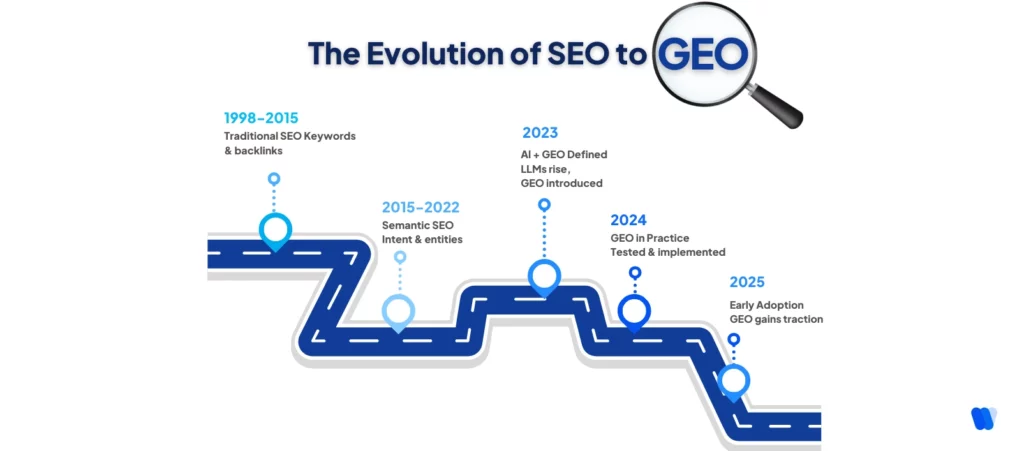
Timeline: From SEO to Generative Engine Optimization
Generative engines are gradually replacing traditional search. Users now expect instant answers instead of scrolling through multiple links. This timeline shows how discovery evolved from backlinks and keyword targeting to GEO practices that prioritize citations and structured responses.
| Period | Phase | Key Milestone |
|---|---|---|
| 1998–2015 | Traditional SEO Era | Google ranks pages using keywords and backlinks; CTR dominated by the first blue link (Backlinko, 2023). |
| 2015–2022 | Semantic SEO Era | Shift to search intent, entity recognition, and natural language queries (Moz, 2022). |
| 2023 | AI Search Goes Mainstream | ChatGPT, Claude, and Gemini emerge as discovery tools. Gao et al. (2023) introduce Generative Engine Optimization (GEO) as a formal framework for AI visibility. |
| 2024 | Industry Awakens | Marketers adopt GEO visibility factors to appear in AI-generated answers. |
| 2025 | Operational GEO | Generative Engine Optimization becomes measurable, testable, and strategically implemented across LLM citations vs backlinks benchmarks. |
To understand how GEO is transforming search, see Google I/O 2025, where Google unveiled AI-driven results that replace traditional blue links with conversational, citation-based overviews—pushing SEOs to adopt Generative Engine Optimization as a core strategy.
History & Academic Origin of Generative Engine Optimization
GEO didn’t start as a marketing tactic.
It emerged at the intersection of SEO fatigue, LLM breakthroughs, and the decline of the SERP as the default discovery path.
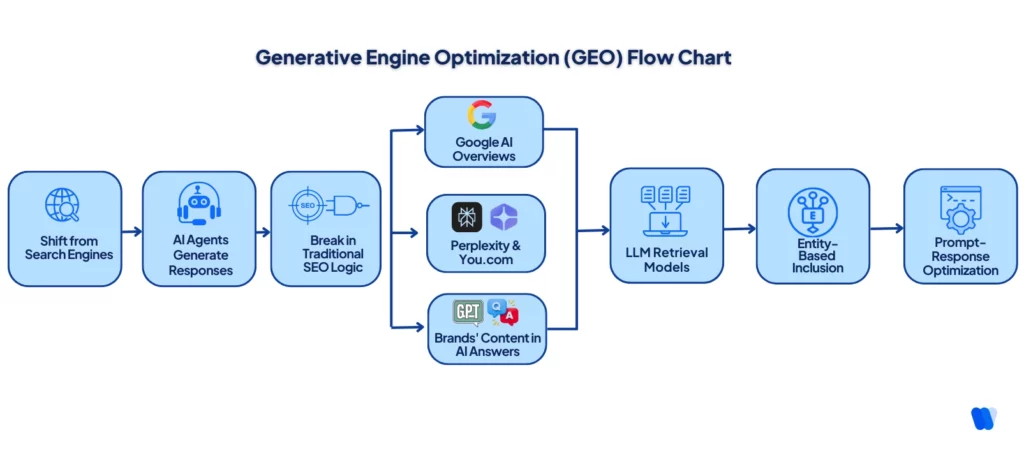
1. Evolutionary Backdrop
By 2023, users were no longer relying solely on Google to find answers. AI agents like ChatGPT, Claude, and Gemini were directly generating responses, bypassing traditional search engines altogether. This shift broke the ranking logic that traditional SEO relied on, prompting a new wave of optimization strategies, particularly for any startups aiming to build visibility from day one.
At the same time:
- Google’s AI Overviews began reducing organic click-through rates.
- Platforms like Perplexity and You.com surfaced citations instead of ranking pages.
- Brands started noticing their content appearing in AI answers, without any control or reporting.
This fragmentation forced the need for a new strategy, not about keyword ranking, but about being the source AI answers pull from.
This is closely tied to the rise of zero-click searches, where users find answers directly in AI-generated overviews or SERP features—without needing to click through to a website.
2. The Academic Origin
In November 2023, a research team led by Yuning Gao, Zheng Liu, Yeyun Si, Yu Meng, Chenyan Xiong, and Ying Lin formally introduced the term Generative Engine Optimization (GEO). Their paper—“GEO: Generative Engine Optimization”—laid the groundwork for thinking about visibility in terms of:
- LLM retrieval models
- Entity-based inclusion
- Prompt-response optimization, not search rankings
This early research also overlaps with what some scholars describe as Generative Model Optimization, focusing on how LLMs themselves retrieve and process content for citation.
“GEO bridges the gap between how models retrieve content and how users interact with answers.”— Gao et al., 2023
This marked the first academic recognition of a problem SEOs were beginning to experience—but hadn’t yet named.
The Rise of Generative Engines
Generative engines represent a new hybrid of search engine retrieval and LLM synthesis —the backbone of AI Agents as web search. They do more than return results—they generate answers, cite real sources, and reshape how users discover information. This shift is driving the adoption of generative engine optimization (GEO), which ensures your content is structured so AI systems can extract, trust, and reference it.
To understand how this shift complements answer-first optimization, see our AEO vs GEO breakdown.
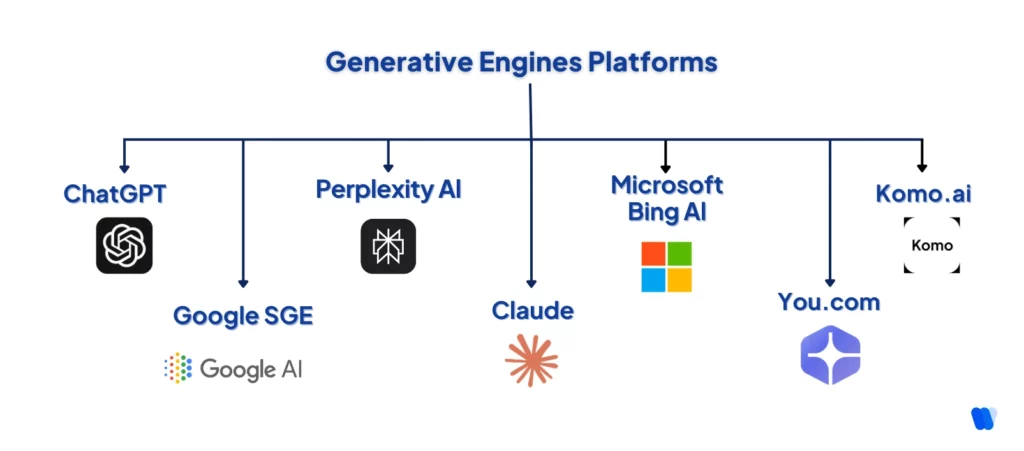
Key Generative Platforms
- ChatGPT
- Google SGE (Search Generative Experience)
- Perplexity AI
- Claude (Anthropic)
- Microsoft Bing AI
- You.com
- Komo.ai
These platforms are redefining the user journey. Instead of scrolling through multiple links,nusers now receive a synthesized answer from a single prompt—often with citations attached. A strong GEO example is when ChatGPT or Perplexity cites your content directly, as shown in the ChatGPT Visibility Experiment.
When content is properly structured for AI parsing, it becomes part of the answer itself—not just another link. To achieve this, brands should study how to earn ChatGPT citation and adopt LLM seeding practices to strengthen their presence in generative results.
For marketing consultants, clarity and structure are essential for AI understanding. With the AI search visibility platform for consultants, content is optimized so LLMs can extract, interpret, and rank it with higher confidence.
Why Generative Engine Optimization Matters Now?
Search behavior is undergoing a seismic shift. As generative AI tools like ChatGPT, Google’s Gemini, and Perplexity become primary sources of information, traditional SEO strategies are no longer enough.
Before diving into why GEO is indispensable, it’s worth asking: what are the benefits of generative engine optimization—and how Multi-Modal GEO ensures your brand’s visuals and audio assets are equally discoverable in AI-driven search? At its core, GEO ensures your brand is not just visible on search engines but cited directly inside AI-generated answers.
Here’s why Generative Engine Optimization (GEO) is becoming indispensable:
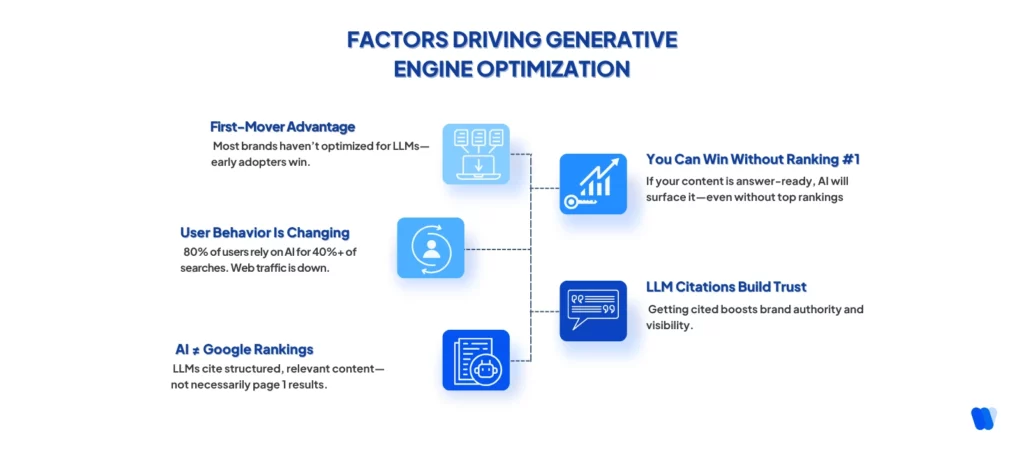
1. Changing User Behavior
Users increasingly rely on AI-driven platforms for information, reducing visits to traditional websites. A Bain & Company survey revealed that 80% of consumers now rely on AI-written results for at least 40% of their searches, reducing organic web traffic by 15% to 25% .
2. Visibility Transformation
Being linked in a search result differs from being cited in an AI-generated answer. Traditional SEO focuses on rankings, but GEO emphasizes inclusion in AI responses, ensuring your content is part of the conversation.
3. New Traffic Patterns
Content optimized for generative engines can gain visibility even if it doesn’t rank highly in traditional search. This shift necessitates a focus on how AI models retrieve and present information.
4. Brand Authority
AI systems cite content they trust. When your brand appears in those responses, you build authority and influence user decisions — reflecting the shift outlined in LLM citations vs backlinks.
As Aleyda Solis explains, “In GEO, a brand mention in an AI response can be more valuable than a click.”
5. First-Mover Advantage
Many organizations haven’t yet adapted their content strategies for generative AI, creating opportunities for early adopters to establish a competitive edge.
As Adam Binder, Founder of Creative Click Media, explains:
“Generative engine optimization (GEO) is the latest evolution in digital strategy, designed to help businesses thrive in the Age of Generative Engines (GEs). If you’re not familiar with GEs yet, you’re about to be. These groundbreaking platforms are rewriting search rules by blending traditional search engines‘ functionality with the power of generative AI.” (Forbes,2025)
GEO vs SEO: What’s The Difference?
Generative Engine Optimization (GEO) builds on SEO, but it works differently. Traditional SEO helps content rank and get clicks on platforms like Google or Bing. In contrast, GEO ensures your content shows up directly inside AI-generated answers from ChatGPT, Claude, Gemini, and Perplexity, making it part of the conversation instead of just a search result.
With the rise of generative SEO, structure, authority, and credibility matter more than keyword density. Generative engine optimization for AI models focuses on clarity and semantic precision, because large language models don’t list results—they synthesize responses using trusted, well-formatted content that aligns with visibility factors.
Elements like clean HTML, proper heading hierarchy, and optimized meta tags play a crucial role in helping LLMs extract and cite content accurately. Without these, even high-ranking SEO pages may not be surfaced in AI-generated answers.
For a full breakdown of how GEO and SEO strategies differ, explore our detailed SEO vs GEO guide. The table below outlines the core differences across five dimensions, showing why GEO is now central to modern visibility.
| Aspect | SEO (Search Engine Optimization) | GEO (Generative Engine Optimization) |
|---|---|---|
| Goal | Rank higher in search results pages to drive clicks | Be featured as a source in AI-generated responses |
| Target Platform | Traditional search engines (Google, Bing) | AI-powered generative platforms (ChatGPT, Perplexity, SGE) |
| Content Focus | Keyword optimization, backlinks, technical SEO | Information structure, authority signals, comprehensive coverage |
| User Experience | Driving website visits | Direct information delivery within AI interface |
| Success Metrics | Rankings, traffic, click-through rates | Citation frequency, influence on AI responses, brand mentions |
Applying both matters. Use this guide to combine SEO and GEO – from technical foundations to AI-ready formatting.
A 2025 study by Aggarwal et al. explains that generative AI and SEO follow different rules. AI engines extract content based on clarity, structure, and semantic trust—not keyword density.
“Unlike traditional SEO, which relies on manual keyword research and content creation, GEO uses advanced AI algorithms to generate content that aligns more precisely with how generative engines process, synthesize, and present information.” — (TheeDigital,2025)
This means even top-ranking pages might not appear in AI answers. To be visible, your content must be easy for models to pull from—using bullets, summaries, and citations.
In practice, this emerging discipline is often called SEO for Generative Engines—a hybrid approach that blends traditional SEO structure with GEO-specific tactics for AI-driven visibility.
That’s where real-world experience comes in.
As Kevin Indig puts it:
“SEO and GEO/AEO are like pianos and guitars. They share fundamental principles but require different techniques to master both effectively.”
— Kevin Indig, Growth Memo
To win in both generative AI and SEO, you need content that ranks—and content that gets reused by AI.
The Academic Foundation of Generative Engine Optimization
The concept of Generative Engine Optimization was formally introduced in a groundbreaking research paper titled “GEO: Generative Engine Optimization” published on arXiv in November 2023. Aggarwal et al. (2023) conducted the first systematic study of optimization methods for generative engines, introducing the formal concept of Generative Engine Optimization.
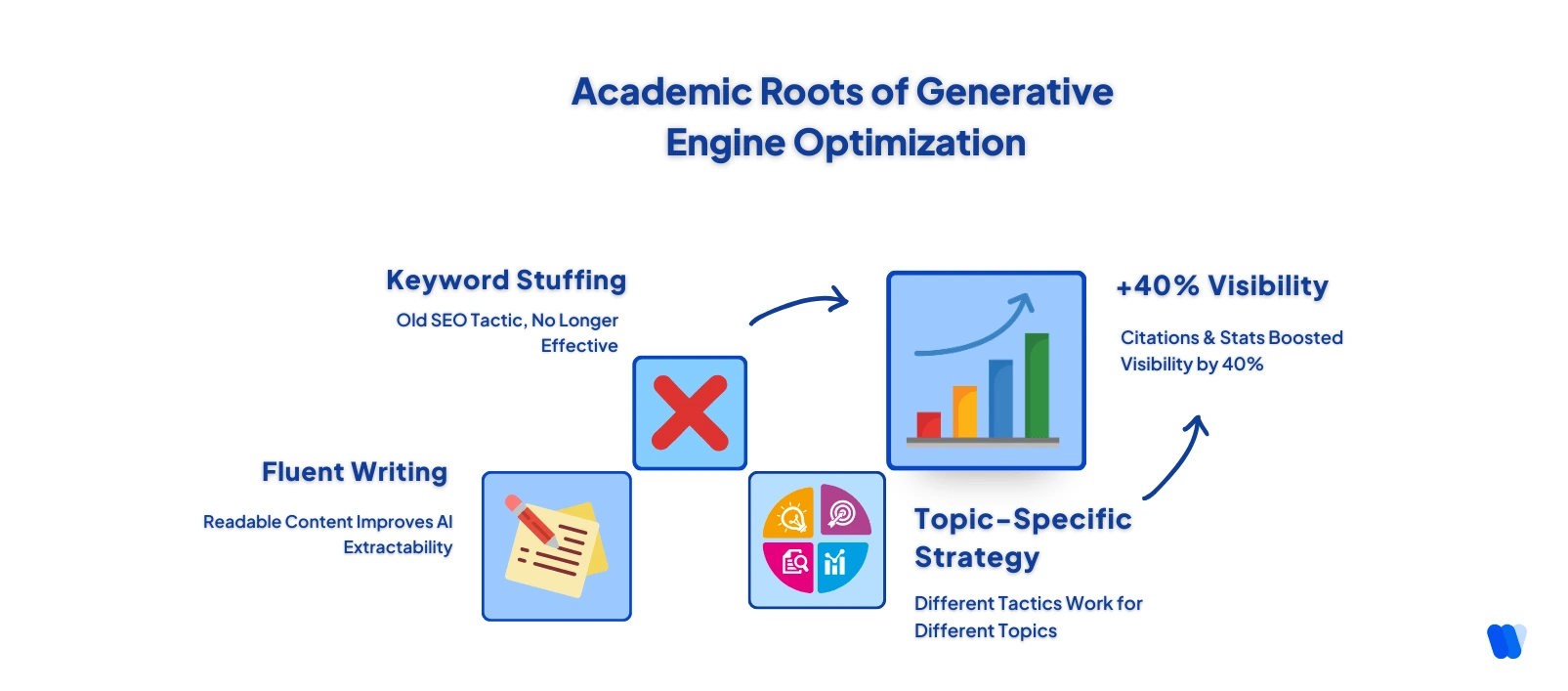
Their key findings revealed:
- Traditional SEO methods like keyword stuffing proved ineffective for generative engines.
- Adding citations, quotations from relevant sources, and statistics significantly boosted source visibility by over 40% in generative engine responses.
- Enhancing content fluency and readability also delivered meaningful improvements in visibility.
- Different optimization methods were more effective for different domains and query types.
The researchers defined GEO as:
“A flexible black-box optimization framework for optimizing web content visibility for proprietary and closed-source generative engines.” (Aggarwal et al., 2024)
How Generative Engine Optimization Works
Understanding how generative engines operate is essential for implementing GEO effectively. These engines follow a workflow that determines how content is discovered and cited:
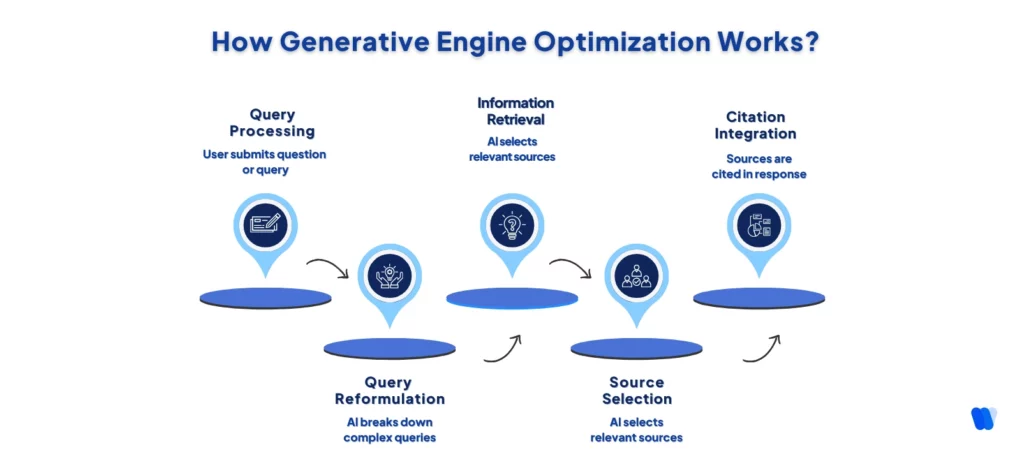
- Query Processing: A user submits a question or query to the generative engine.
- Query Reformulation: The AI may break down complex queries into simpler sub-queries to improve accuracy.
- Information Retrieval: The engine searches for relevant information from the web or its knowledge base.
- Source Selection: It evaluates and selects the most authoritative, contextually relevant sources.
- Response Generation: The AI synthesizes insights from those sources into a coherent, natural-sounding answer.
- Citation Integration: Sources are cited or referenced inline to provide attribution and verification.
How GEO Platforms Help Brands Adapt?
This process happens automatically, but GEO platforms step in to give brands control and visibility. They analyze how engines retrieve, interpret, and present information, then provide tools to align your content with that workflow:
- Content Analysis and Optimization: Audits existing content and ensures it’s structured with schema, headings, and concise language so AI models can easily parse it.
- Keyword and Query Alignment: Identifies natural language queries that users enter into generative engines and optimizes your content to match them.
- Monitoring AI Citations: Tracks how often and in what context your brand or content is mentioned in AI-generated answers, helping you measure visibility.
- Competitive Analysis: Assesses how competitors are performing in generative results and uncovers opportunities to strengthen your positioning.
Together, the engine workflow and the platform tools create the foundation of GEO. Engines decide what gets included; platforms give you the insight and levers to improve your chances of being chosen. Unlike traditional search, where keyword matching dominated, generative engines reward structured, trustworthy, and semantically clear content.
“Generative Engines primarily consist of a set of generative models and a search engine to retrieve relevant documents. Generative Engines take user queries as input and generate responses grounded in retrieved sources with inline attributions.” (Aggarwal et al., 2024)
Now that you see both sides—how engines function and how platforms enhance visibility—the next step is to align your content strategically. A practical way to start is by following an LLM pattern analysis checklist, which identifies recurring extraction and citation behaviors across ChatGPT, Gemini, DeepSeek, and Claude. Doing so increases the likelihood of being included in AI-generated answers.
Effective Framework for Generative Engine Optimization (GEO)
Generative Engine Optimization (GEO) is a strategic approach aimed at enhancing the visibility of digital content within AI-driven search results and generative AI responses. While traditional Search Engine Optimization (SEO) focuses on improving rankings in conventional search engines, GEO targets generative engines—AI systems that synthesize and present information directly in response to user queries.
To effectively implement GEO and maximize results, use this framework:
- Understand user intent and conversational queries: Analyze prompt patterns and question phrasing to align content with user expectations and the conversational context of AI-generated responses.
- Align content to the journey: Map answers to awareness → consideration → conversion so each page addresses a specific intent and is more likely to be featured in AI outputs.
- Optimize structure for extraction: Use clear headings, bullets, summaries, and concise language so models can digest, cite, and summarize reliably.
- Enhance entity recognition: Implement structured data (e.g., Organization, Person, Article, FAQ) and keep entity details consistent across the web to improve machine readability.
- Build credibility through citations: Earn mentions on reputable sites, contribute thought leadership, and maintain a consistent off-site presence to signal authority to AI engines.
- Simplify language & improve readability: Prefer plain language and shorter sentences so models can parse and reuse your content accurately.
- Ensure fluency and error-free copy: Edit for clarity and correctness; cleaner prose increases selection and citation in AI answers.
Apply this framework to make your content easier for generative engines to find, understand, and cite—boosting visibility and engagement across AI-driven results.
How to Measure Generative Engine Optimization Success?
Marketers often ask: how is performance measured in generative engines? Unlike traditional SEO metrics where clicks and rankings dominate, GEO performance is measured through metrics such as citation frequency, extraction rate, response positioning, attribution accuracy, and influence score.
To effectively assess your Generative Engine Optimization efforts, consider these GEO KPIs for better measurement.
- Citation Frequency: Track how often your content is cited in AI-generated responses across platforms like ChatGPT, Perplexity, and Google’s SGE.
- Content Extraction Rate: Measure the percentage of your content being extracted and used in AI responses. A higher extraction rate indicates better alignment with AI retrieval mechanisms.
- Response Positioning: Assess where your citation appears within the AI-generated response. Earlier mentions typically equate to higher visibility and influence.
- Attribution Accuracy: Ensure that AI systems correctly attribute information to your brand or website. Misattributions can dilute brand authority and trust.
- Influence Score: Evaluate how significantly your content shapes the overall AI-generated response. This includes assessing the prominence and impact of your information within the answer.
Utilizing tools like AI search simulators and structured data testing platforms can aid in monitoring these metrics and refining your GEO strategies accordingly. Collectively, these benchmarks provide a framework for improving generative engine efficiency, ensuring content is optimized for both retrieval and citation
What is Generative Engine Optimization Implementation Process?
Implementing an effective GEO strategy involves a systematic approach:
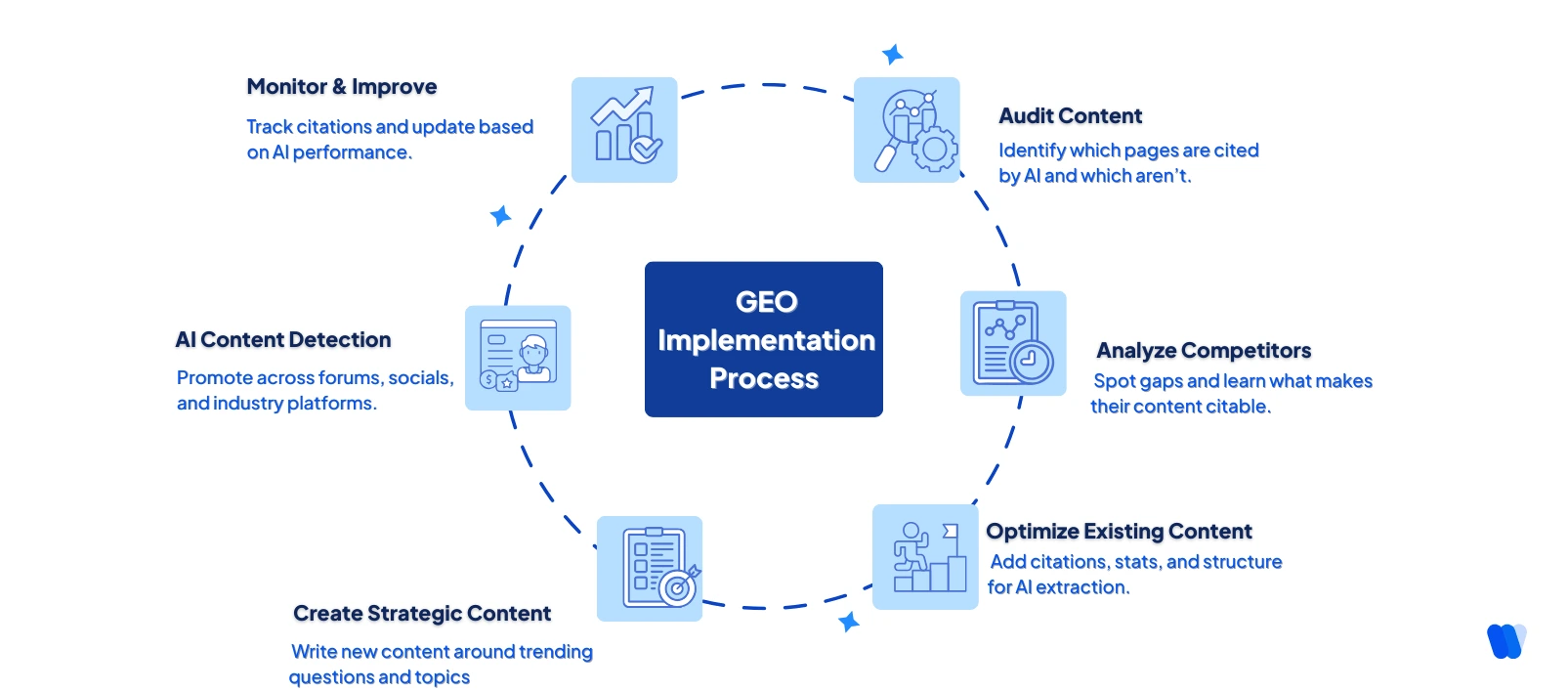
1. Content Audit:
- Identify existing content that is or isn’t being cited by AI systems.
- Determine which pages have high potential for AI visibility.
2. Competitive Analysis:
- Analyze competitors’ content to understand what makes their material more citable.
- Identify gaps in their content that your brand can fill.
3. Content Optimization:
- Incorporate relevant citations, statistics, and authoritative quotes based on patterns shown in the ChatGPT-4o prompt leak.
- Enhance content fluency and readability.
- Structure content for easy extraction by AI systems.
- Optimize for entity recognition to improve context understanding.
4. Strategic Content Creation:
- Develop new content targeting common questions and trending topics in your industry.
- Create comprehensive resources that establish authority on specific subjects.
5. Distribution and Amplification:
- Share optimized content across authoritative platforms and communities.
- Engage in relevant forums and social media groups to increase content reach.
- Seek mentions in industry publications to boost credibility. This aligns with the long-term content goals of the AI search visibility platform for agencies, helping teams amplify reach and authority across every channel.
6. Monitoring and Refinement:
- Continuously monitor AI citations and content performance.
- Experiment with different optimization techniques.
- Update content based on performance data and evolving AI behaviors.
This ongoing refinement is essential for enhancing generative engine performance—helping content remain visible as AI models evolve.
How I Measured GEO Implementation Across AI Platforms?
GEO (Generative Engine Optimization) isn’t just a concept, it’s a measurable visibility layer across large language models. I ran a real-world experiment using 5 industry-specific prompts across ChatGPT, Gemini, Claude, and DeepSeek to test how well GEO techniques perform across today’s leading LLMs.
Below is how I collected the data, what framework I used, and what the results revealed, industry by industry.
1. My Framework: How I Measured GEO Performance
This research used the academic visibility model proposed by (Aggarwal et al., 2024), which introduced performance metrics tailored for generative engines. These metrics are fundamentally different from traditional SEO KPIs like rankings or CTR.
| Metric | Academic Source |
|---|---|
| Citation Frequency | Aggarwal et al., arXiv:2311.09735 (Impression Metrics) |
| Citation Position | Aggarwal et al., arXiv:2311.09735 (Position-Adjusted Word Count) |
| Content Extraction | Aggarwal et al., arXiv:2311.09735 (Word Count per Citation) |
| Attribution Accuracy | Search Engine Land (Subjective Relevance + Attribution Traceability) |
These were adapted into observable, testable fields for each AI platform.
2. Data Collection Process
I tested one query per industry across four LLMs:
- ChatGPT (Browsing Enabled)
- Google Gemini
- Claude (Anthropic)
- DeepSeek AI
Each query was selected to reflect how a typical user might search, while still being aligned with GEO-optimized content (e.g., articles featuring citations, schema, statistics, or entity-rich formatting).
3. Industry-Specific Queries Used for Testing
These queries were selected to reflect real-world, high-intent questions users are asking LLMs across major verticals. Thus, each one was tested across ChatGPT, Gemini, Claude, DeepSeek, and Perplexity to observe differences in interpretation, structure, and citation behavior.
| Industry | Query |
|---|---|
| Finance | What are the best AI investment strategies in 2025 according to financial experts? |
| Technology | How does generative AI improve SEO for websites and marketers? |
| Fashion | How is AI being used in fashion design and online shopping today? |
| E-Commerce | What are the biggest e-commerce trends for 2025 that brands should prepare for? |
| Health | How is AI helping doctors detect diseases like cancer or heart problems? |
Each query was evaluated for:
- Frequency of citation
- How early in the response the citation appears
- How much content is pulled from the source
- Whether the source was clearly and accurately named
LLM-Wise GEO Performance Analysis
To evaluate which LLMs are truly “GEO-ready”, I tested five industry-aligned queries across ChatGPT, DeepSeek, Claude, and Gemini. Each model’s output was assessed using four research-backed metrics adapted from Aggarwal et al. (2023) and Search Engine Land:
- Citation Frequency – how many unique sources were cited
- Citation Position – word position of first citation as % of total response
- Words Extracted – total quoted/paraphrased content from each source
- Attribution Accuracy – whether the source was named and credited properly
1. ChatGPT – High-Frequency, High-Volume, Mostly Accurate
After running five queries across five verticals, we analyzed how ChatGPT performed in terms of citation frequency, attribution accuracy, and the number of words it extracted from each source.
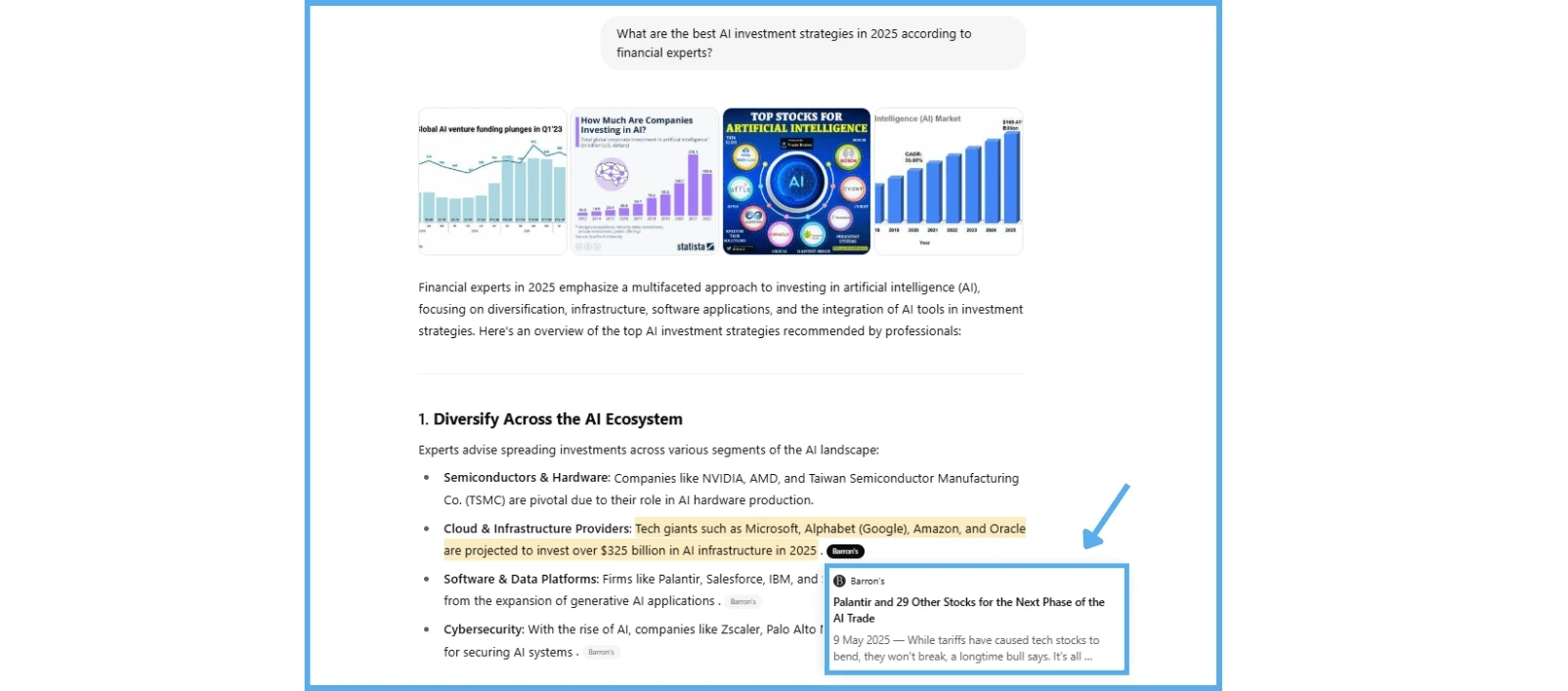
This is the screenshot showing how ChatGPT responded to our finance-related query: “What are the best AI investment strategies in 2025 according to financial experts?”
As you can see, the model cited Barron’s clearly within a well-organized, list-based explanation. I analyzed this output closely and noticed a few key things:
-
The citation appeared early—at about 14% into the total response length
-
The answer was structured using bullet points and short paragraphs, making it easy to extract
-
ChatGPT pulled 180+ words of relevant content before surfacing the source, which was properly hyperlinked
This suggests ChatGPT is capable of citing sources reliably—but only if the content is well-structured and matches the way users phrase their questions.
Now, let’s look at how ChatGPT performed across all five industries in the table below.
| Industry | Citation Freq | Citation Position (%) | Words Extracted | Attribution Accuracy |
|---|---|---|---|---|
| Finance | 6 | 14% | 185–210 | Yes |
| Technology | 2 | 15.6% | 85–110 | No |
| Fashion | 7 | 13% | 180–220 | Yes |
| E-Commerce | 7 | 13% | 180–220 | Yes |
| Health | 9 | 11.3% | 210–240 | Yes |
2. DeepSeek – Highly Accurate, Moderate Volume
After submitting the same set of five industry-specific queries to DeepSeek, I analyzed how the model responded in terms of citation structure, attribution accuracy, and content formatting.
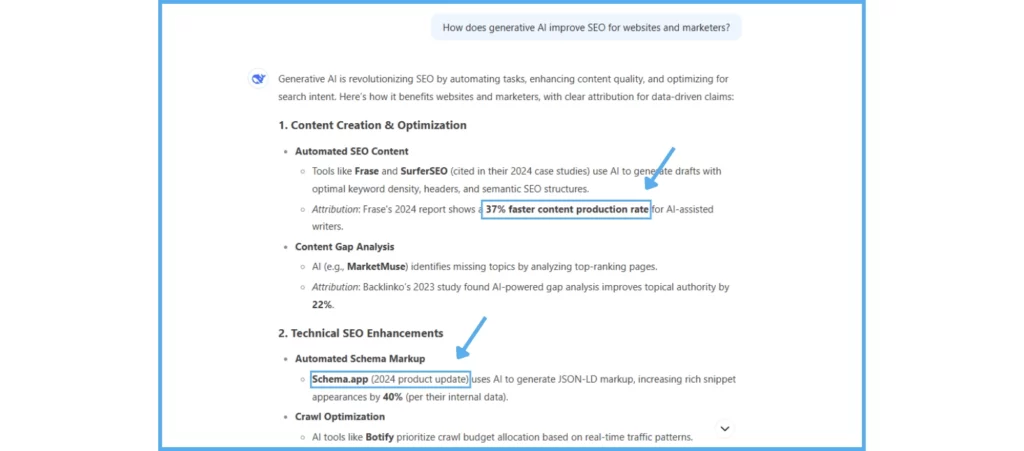
This is the screenshot showing how DeepSeek responded to the technology query: “How does generative AI improve SEO for websites and marketers?”
What stood out immediately is DeepSeek’s precision in source attribution—the model cited multiple tools (like Frase, SurferSEO, MarketMuse, and Schema.app) and even highlighted performance metrics (e.g., “37% faster content production rate” and “40% increase in snippet visibility”).
I analyzed this response carefully and noticed three key things:
- Citations were well distributed, with most appearing between 15–88% into the response
- The language was direct and fact-based, ideal for technical summaries
- The model extracted an average of ~90–140 words per source, depending on the query
Thus, compared to ChatGPT, DeepSeek delivered fewer words per citation, but was much stronger in early citation and source accuracy—making it ideal for use cases where precise attribution matters.
Let’s look at how DeepSeek performed across all five industries in the table below.
| Industry | Citation Freq | Citation Position (%) | Words Extracted | Attribution Accuracy |
|---|---|---|---|---|
| Finance | 6 | 18.6% | ~87 | Yes |
| Technology | 7 | 15% | ~94 | Yes |
| Fashion | 9 | 8% | ~112 | Yes |
| E-Commerce | 14 | 10% | ~147 | Yes |
| Health | 12 | 13% | ~132 | Yes |
3. Claude – High Fluency, Zero Visibility
After running the same set of queries through Claude, I noticed a consistent but limiting pattern. The model delivers well-written, logically structured summaries, but fails to mention or cite any external sources across all industries.
Below is the screenshot showing Claude’s response to the Health query: “How is AI helping doctors detect diseases like cancer or heart problems?”
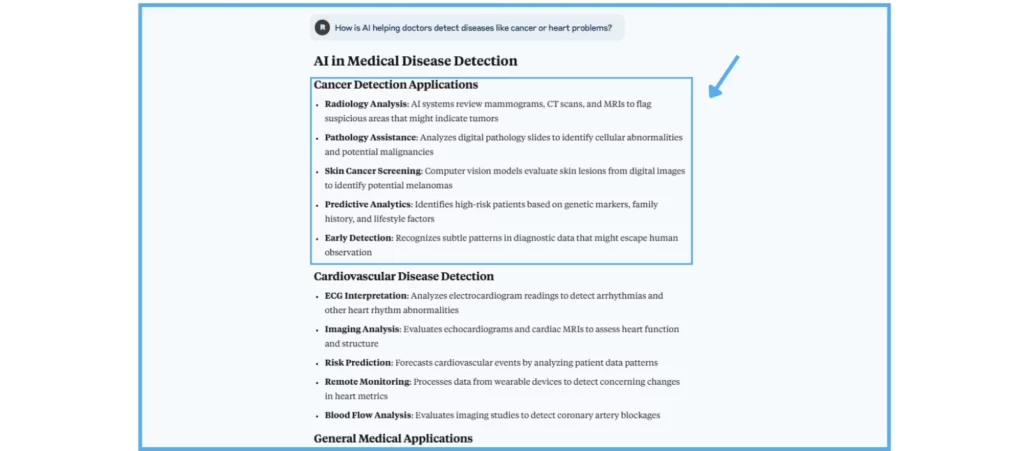
When I tested Claude on the health query, I was impressed by how neatly it structured the response. It used bold section headers like Cancer Detection and Cardiovascular Disease Detection, and the bullet points were clear and concise, very easy to follow.
But as I read through it, something was missing: not a single source was cited. No medical studies, no journal names, not even brand mentions. It felt more like a well-written blog summary than a traceable AI answer.
From a GEO standpoint, this is a deal-breaker. So, if you’re looking to get cited or included in LLM outputs, Claude offers zero extractability and no attribution—at least for now.
4. Gemini – Informative, Yet Not GEO-Compliant
After submitting the fashion query to Gemini, I wanted to see whether it could balance fluency with citation. The model pulled from live search results, as expected—but the output raised immediate concerns.
Here’s the screenshot of Gemini’s response to: “How is AI being used in fashion design and online shopping today?”
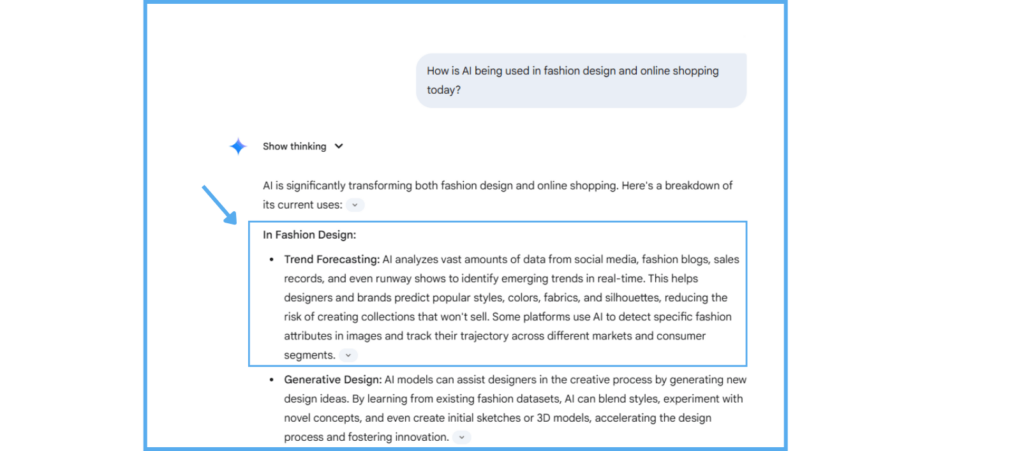
Despite the clean format and structured breakdown, Gemini failed to cite any named sources. While the response sounded authoritative, there were no brand mentions, links, or external references—not even for widely known tools or reports.
From a GEO perspective, this limits its usefulness. Gemini delivers helpful summaries but lacks the attribution and extractability needed for brand inclusion or content traceability.
Final Verdict
To evaluate which models support generative engine optimization, I tested how top LLMs—ChatGPT, DeepSeek, Claude, and Gemini—handle citations, attribution, and content extraction across five real-world industry queries.
First, I analyzed each model’s ability to recognize trusted sources and surface them in AI-generated answers. Then, I tracked how often and how accurately they cited content. The goal was simple: identify which LLMs help brands gain visibility through generative engine AI.
Here’s how they performed:
| LLM | Overall GEO Suitability | Citation Capability | Attribution Accuracy | Use Case Fit |
|---|---|---|---|---|
| ChatGPT | ⭐⭐⭐⭐⭐ | High | Mostly accurate | Best for full-funnel GEO |
| DeepSeek | ⭐⭐⭐⭐ | High | Perfect | Great for source recall |
| Claude | ⭐ | None | None | Not GEO-compatible |
| Gemini | ⭐ | None | None | Informative but non-traceable |
Clearly, not all models are GEO-ready. ChatGPT and DeepSeek stood out for consistently citing sources and paraphrasing with context. In contrast, Claude and Gemini delivered helpful summaries—but failed to attribute, making them less useful for brand visibility. Brands can use Gemini visibility tips to address these gaps.
“A lot of the things we do as good SEO are also going to help us with GEO. But there’s other things that we can do as well.”
— Marie Haynes, SEO & AI Consultant
Her point reinforces the shift underway. While SEO still matters, generative engine optimization adds new layers. Now, content must do more than rank—it must be readable by machines, structured for extraction, and cited in AI responses.
Therefore, if you want to compete in an AI-first world, optimize for how LLMs process and present content—not just how search engines rank it.
Key Benefits:
– Enhanced content visibility: Optimizing for generative engines increases the chances of being featured in AI answers, leading to stronger exposure. A 2024 academic study showed citation-focused optimization boosted AI answer inclusion rates by 40%+.
– Improved user engagement: Content formatted for AI models tends to be more concise and intent-driven, improving user satisfaction and overall experience.
– Authority and trust building: E-E-A-T aligned citations strengthen brand credibility across both AI platforms and search ecosystems.
– Future-proofing against zero-click trends: GEO helps mitigate traffic loss by ensuring your content still shapes AI-driven decisions.
– Competitive advantage: Early GEO adoption positions businesses ahead of competitors in the AI-driven search landscape, keeping them visible as user habits evolve.
– Adaptation to evolving search trends: As AI platforms grow, GEO ensures brands stay aligned with new discovery methods, maintaining long-term relevance.
– Diversified traffic channels: GEO opens up new visibility opportunities beyond traditional Google rankings or social media reach.
– Cross-platform discoverability: Optimized content works across ChatGPT, Claude, Perplexity, Gemini, and Google’s AI Overviews.
Recent Trends & GEO Developments (2024–2025)
As generative AI platforms like ChatGPT, Gemini, and Perplexity become integrated into everyday search behavior, SEO is expanding beyond traditional rankings. Generative Engine Optimization (GEO) has emerged as a critical layer for ensuring visibility inside AI-generated answers—not just on the SERP.
Many professionals are now exploring are there case studies on successful generative engine optimization to understand how early adopters are achieving measurable results with AI-driven citations and entity recognition.
Below is a breakdown of the most important developments reshaping SEO and GEO between 2024 and 2025, supported by recent GEO statistics.
1. Google’s AI Overviews Will Dominate the SERP
Google’s Search Generative Experience (SGE) launched in May 2024 and expanded to 100+ countries by early 2025. In March 2025, a new “AI Mode” toggle was introduced, hinting at a future where generative summaries might replace blue links for top-of-funnel queries.
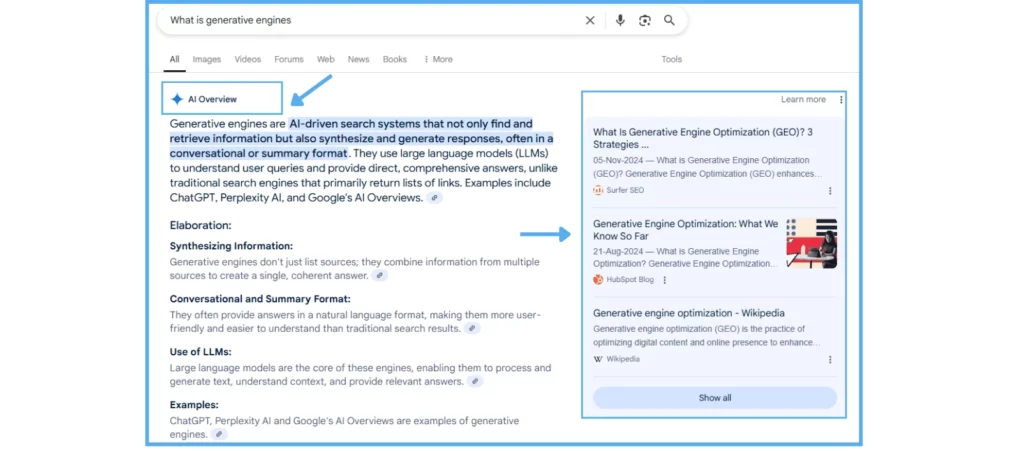
Currently, only ~15% of SERPs feature an AI overview—but that number is expected to grow. These overviews are part of a broader semantic AI rollout, powered by technologies like Project Astra, which changes how Google structures and ranks answers.
According to Backlinko’s analysis, the top result traditionally gets a 27.6% CTR, yet early data suggests AI overviews could reduce organic clicks by 18–64%, as more users find answers directly on the results page, without clicking through.
2. LLMs Are Stealing Market Share from Google
October 2024 marked a turning point—Google’s market share dropped below 90% for the first time since 2015.
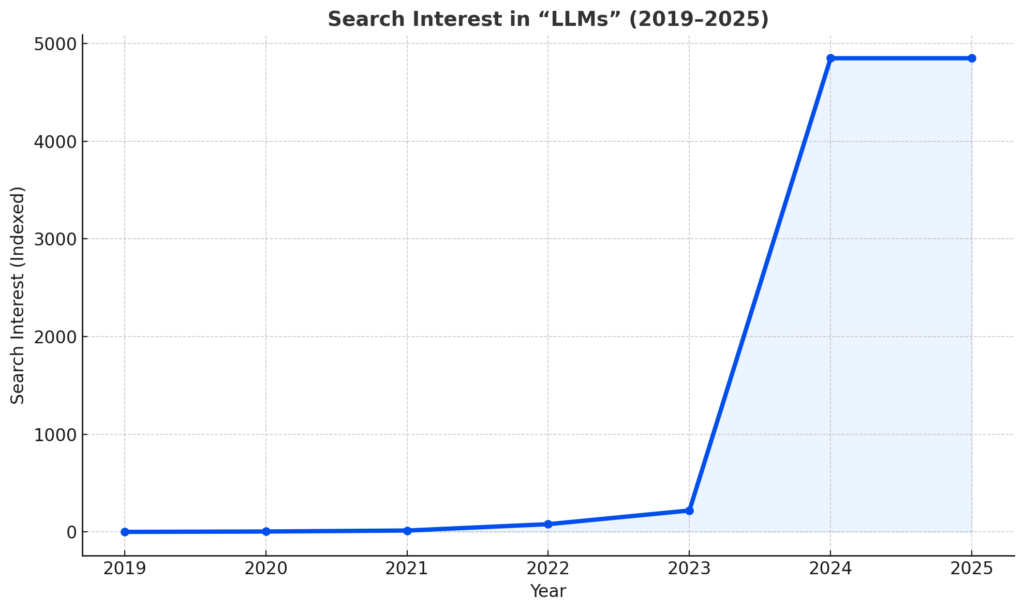
Meanwhile, tools like ChatGPT, Claude, and Perplexity AI are being used not only for answers, but for writing, coding, and SERP-skipping research. These platforms are gaining user preference due to:
-
Conversational search
-
Zero-click summaries
-
Ad-free, contextualized responses
3. Reddit & Quora Surge as UGC Outranks AI Content
Search engines are prioritizing user-generated content (UGC) over generic AI articles. Reddit’s organic traffic has grown 603.41% since June 2023, while Quora is up 379.33%.
Unlike AI content, which often lacks depth and real-world nuance, UGC resonates because it reflects personal experience, opinions, and trust.
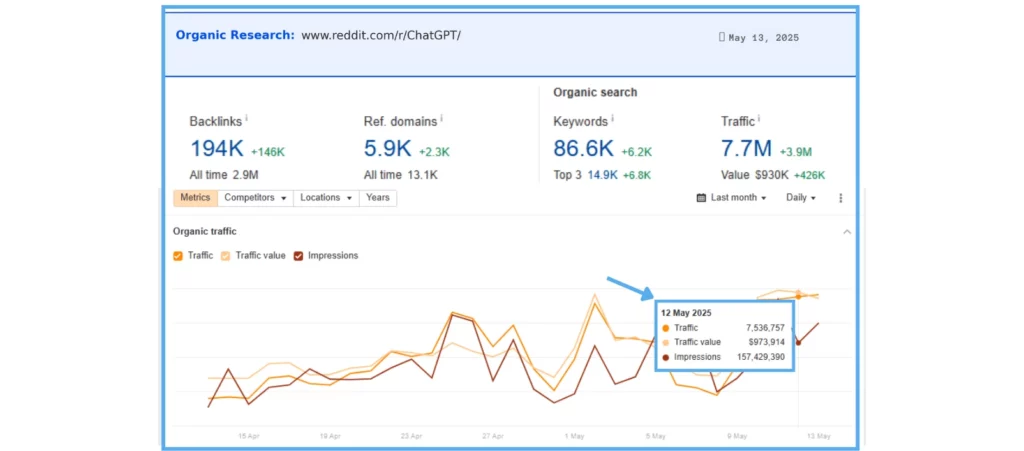
Source: Screenshot from Ahrefs, showing Reddit’s organic traffic trends as of May 2025.
As the chart highlights, Reddit’s traffic surpassed 7.5 million monthly visits, with impressions nearing 157 million—a clear sign that platforms rooted in authentic UGC are gaining SEO momentum. Check out Reddit strategies to capitalize on this growth.
Google is rewarding platforms with real user input—particularly for queries where authenticity and human insight matter. This shift has led many brands to incorporate Reddit SEO strategies and community-first content distribution.
4. SEO Workflows Are Being Rebuilt with AI Tools
Today, 86% of SEO professionals use AI in their workflows, with AI SEO interest growing by 1,900% in five years.
Examples:
-
Perplexity: used to automate content research
-
SEMrush Market Explorer: AI-assisted market and trend analysis
-
ContentShake AI: generates SEO content 12x faster
-
Exploding Topics + ChatGPT: used by Brian Dean’s team for fast keyword ideation
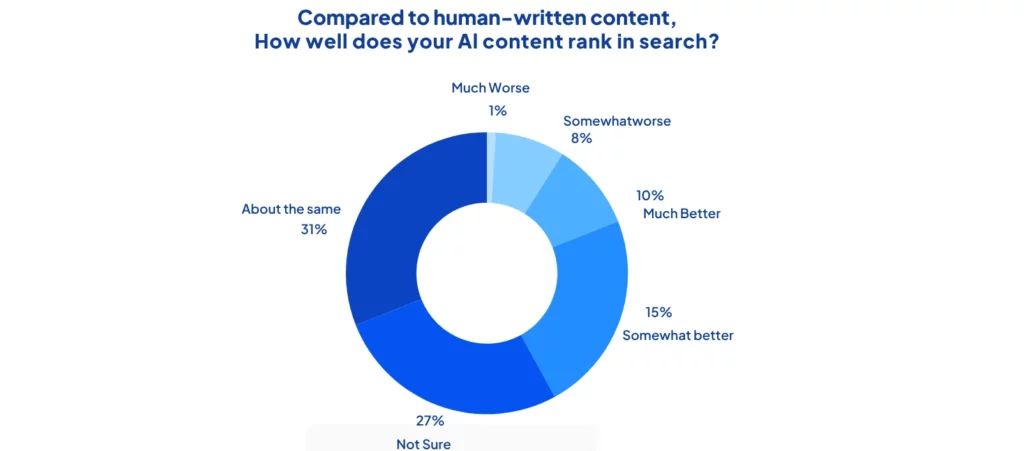
Importantly, a Semrush study showed that AI-written content ranks almost identically to human-written content when properly edited—57% of AI content ranked in the top 10 results.
5. E-E-A-T and Brand Signals Will Matter More Than Ever
As generative engine AI reshapes how users find information, Google is placing more weight on trust signals. E-E-A-T (Experience, Expertise, Authoritativeness, and Trustworthiness) and brand presence now play a critical role in visibility—especially in AI-generated results.
To systematically improve these signals, brands can use an E-E-A-T strengthening SEO checklist using LLM outputs, ensuring that content demonstrates clear expertise, cites reputable sources, and aligns with off-site trust indicators.
Over the past five years, searches for “eeat” have grown by 344%, reflecting this shift. Platforms like YouTube, Twitter, and Instagram now influence whether your content appears in AI Overviews.
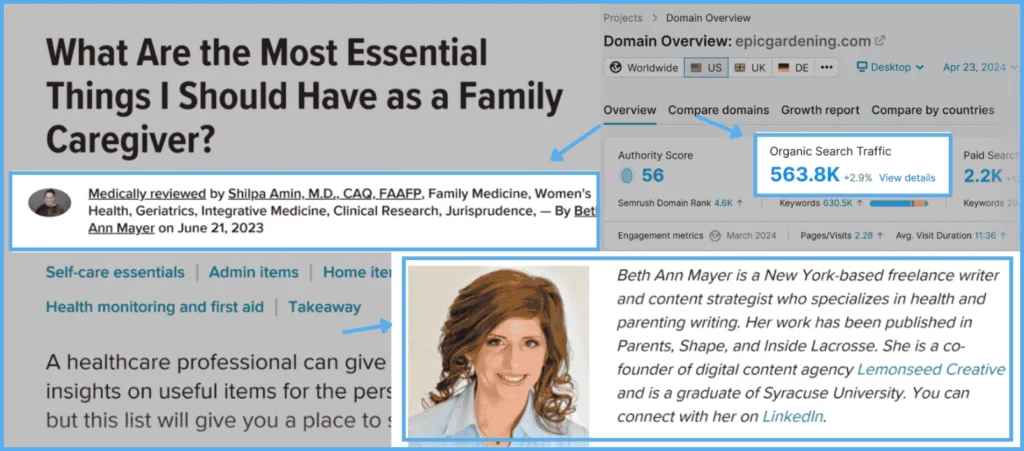
This image shows how Google surfaces content that demonstrates clear E-E-A-T—through expert review, real authorship, and off-platform credibility. These are the same trust signals that generative engine optimization relies on to earn citations inside AI-generated summaries.
“Content with high E-E-A-T and clean formatting is more likely to be surfaced by AI.”
— Lily Ray, Amsive Digital
Close the loop with PR for Generative Engine Visibility —earned media that LLMs can verify and cite.
To succeed with generative engine AI, you must publish content that builds trust—through structured formatting, author visibility, and external signals.
Google’s own results show that brands with a strong digital footprint across social media, podcasts, and expert networks are now earning citations and featured snippets across both search and AI platforms.
What Challenges Do Brands Face in Generative Engine Optimization?
Generative Engine Optimization (GEO) offers huge opportunities, but it also comes with challenges that can’t be ignored. Unlike traditional SEO, where ranking factors are better known, GEO is still evolving—and brands must deal with new hurdles to stay visible in AI-driven answers.
- Lack of transparency: Generative AI works like a black box. Brands rarely know why certain sources are cited while others are ignored, making it harder to fine-tune strategy.
- Limited attribution: AI tools sometimes blend insights without clear source citations, leaving your brand’s contribution invisible or misattributed.
- Constantly changing AI behavior: Models like ChatGPT, Gemini, and Claude update often, so GEO strategies need regular monitoring and adjustments.
- Quality control risks: AI can surface outdated or inaccurate data. Without careful content review, your brand’s authority could take a hit.
- Originality issues: Producing content that sounds too similar to existing material risks duplication and weakens brand differentiation.
- Integrity concerns: Summaries generated by AI may distort meaning—especially risky for industries like healthcare, finance, or law where accuracy is critical.
- Balancing SEO and GEO: Brands must split resources between traditional SEO (for Google) and GEO (for AI engines). Focusing on one while neglecting the other limits long-term visibility.
- Measuring success: Classic SEO metrics like CTR and rankings don’t fully apply. GEO success is about citations, attribution accuracy, and influence inside AI responses.
- Resource gaps for small teams: Comprehensive GEO strategies often demand tools and expertise that smaller businesses may not have.
Overcoming these challenges requires adaptability, smarter content structures, and ongoing monitoring. Brands that prepare now will be better positioned as GEO becomes a standard part of digital visibility.
What This Means for GEO?
The takeaway? You can’t treat SEO and GEO separately anymore.
GEO in 2025 = Ranking on Google + Getting Cited by ChatGPT
To future-proof your strategy:
-
Optimize for AI Overviews
-
Format content for LLM parsing (FAQs, bullets, source formatting)
-
Build entity trust through schema and off-site brand building
-
Track LLM citations via tools like Peec.ai or SEO.ai
-
Monitor shifting CTR and traffic from zero-click SERPs
Read More Articles
- How can AI-Powered insights replace guesswork in SEO research
- Why Structured SEO Briefs Are the New Foundation of AI Search Success
- How to Understand User Intent in Generative Engines?
- Can GSC Data Guide Your GEO Strategy?
- How Will Google’s AI Mode Transform Traditional SEO Practices?
- How Can Pattern Recognition Improve Visibility in AI-Generated Answers?
- How to Design Content Briefs for GEO?
- How to Unlock Client Retention with AI-Powered SEO Workflows
FAQs
Generative Engine Optimization (GEO) is the practice of structuring and optimizing content so it can be cited, quoted, or included in AI-generated answers. Instead of ranking on a traditional SERP, GEO ensures visibility inside platforms like ChatGPT, Claude, Gemini, and Perplexity.
To implement GEO, start with a content audit, analyze competitor visibility, and optimize pages for clarity, citations, and entity recognition. Use clean HTML, add schema markup, include expert quotes, and track LLM citations with tools like Peec.ai or SEO.ai.
Popular GEO tools include Peec.ai for citation tracking, SEO.ai for AI visibility analysis, Semrush for technical SEO integration, and Perplexity for monitoring generative responses. These tools help brands measure how often and where content is cited by AI engines.
Yes. Several studies and reports highlight GEO in action. For example, Foundation Inc. showed how brands gained AI visibility through structured formatting, while Aggarwal et al. (2023) confirmed citations increased by 40% when content used statistics and external references.
Challenges include misattribution by AI models, dependency on closed LLM ecosystems, limited visibility reporting, and competition with user-generated content. Brands must balance technical formatting, authority signals, and off-site mentions to stay cited reliably.
Traditional SEO focuses on ranking in search engines through keywords and backlinks. GEO, on the other hand, optimizes for AI engines by emphasizing structure, authority, and semantic clarity. The goal isn’t ranking—it’s being cited inside AI-generated answers.
Yes. Dedicated GEO trackers measure how often and where your brand appears in AI answers, with trendlines and competitor comparisons. Platforms like Finseo.ai, AISEOTRACKER, and SE Ranking’s AI Visibility Tracker monitor mentions across ChatGPT, Perplexity, Claude, Gemini, and AI Overviews, showing citation frequency, placement, and attribution so you can spot gaps and optimize what gets surfaced.
Conclusion
Generative Engine Optimization (GEO) transforms how we approach content visibility in an AI-first world. While traditional SEO continues to drive web traffic, GEO ensures your content appears directly in AI-generated answers.
As AI platforms like ChatGPT, Gemini, and Claude reshape search behavior, you must adapt your strategy. Moreover, research confirms that structured formatting, strong citations, and semantic clarity significantly increase your chances of being cited.
Therefore, by applying the GEO strategies outlined in this guide, you position your brand to stay visible, relevant, and trusted—no matter how search evolves.