Content Readability in SEO is now a key factor in ranking performance — hard-to-read content frustrates users and sabotages SEO success. According to Semrush (2025), 73% of users abandon pages within 10 seconds if readability is poor.
Content clarity metrics improvement SEO extends beyond writing standards; it’s a crucial part of on-page optimization. If users can’t easily digest your content, even the best keywords or fastest loading speed won’t help.
Whether you’re optimizing for clients or managing your own content hub, understanding the connection between SEO and readability helps you improve both rankings and user experience.
Let’s explore how it works, how to measure it, and how to fix it effectively.
What is Content Readability in SEO?
Content readability in SEO is the degree to which users can quickly understand your page, driven by sentence length, word choice, structure, and visual formatting. High readability reduces friction, improves engagement, and supports search intent fulfillment—key factors AI systems use when selecting content for AI Overviews optimization.
These foundations are often described as SEO readability of content or SEO-friendly content readability, both emphasizing clarity that serves users and search engines.
Content accessibility standards refer to how easy it is for someone to consume and understand your content. This includes the words you use, the length of your sentences, the layout of your paragraphs, and how clearly your ideas flow.
In SEO, readability helps:
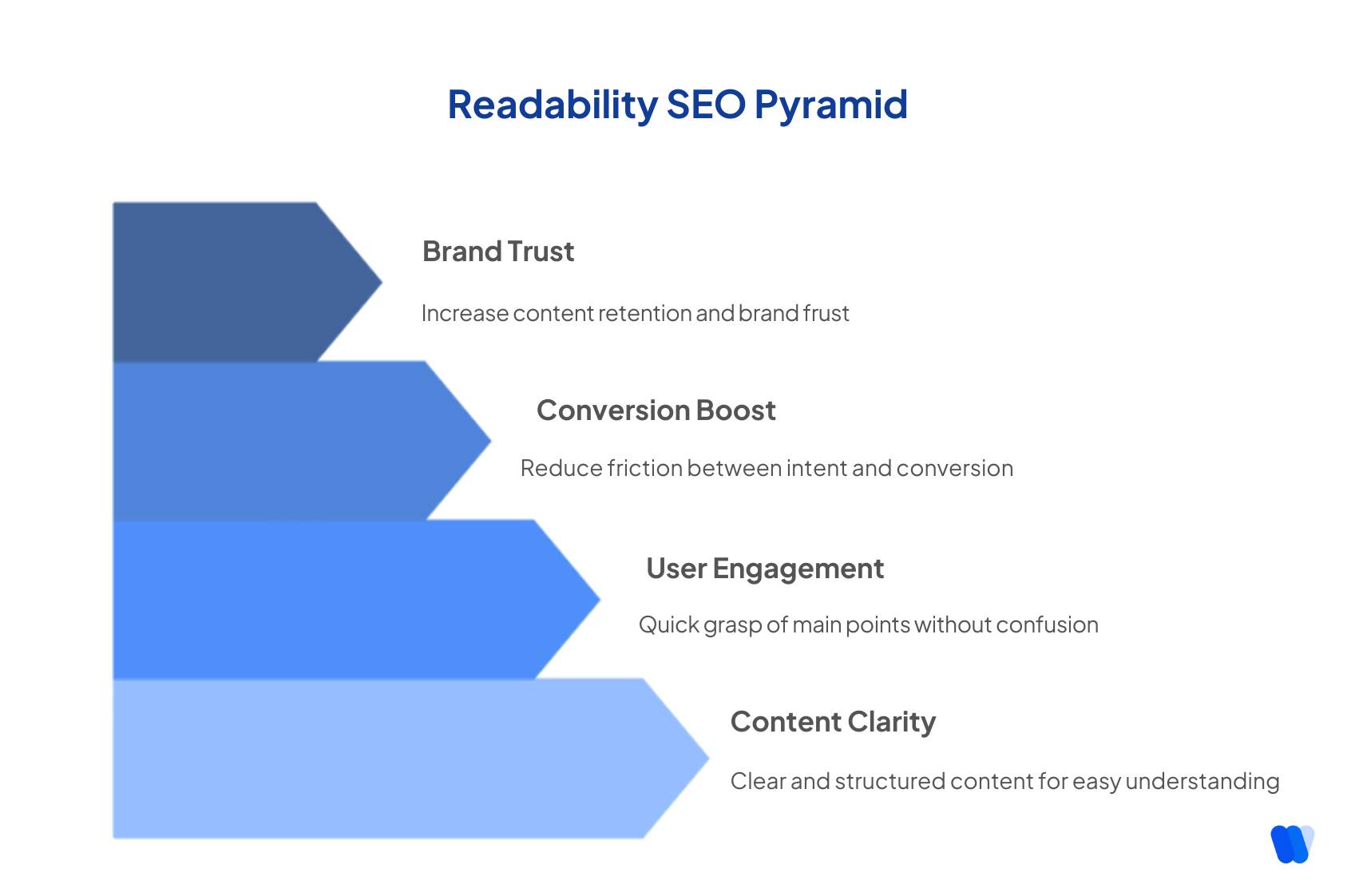
- Users quickly grasp the main points without confusion
- Reduce friction between intent and conversion
- Increase content retention and brand trust
“In short, readability SEO is about making your content clear, structured, and approachable, not only for search engines but for actual people. Understanding this foundation becomes crucial when examining how search algorithms actually process and evaluate content readability signals.
Why Readability Influences Search Engine Rankings?
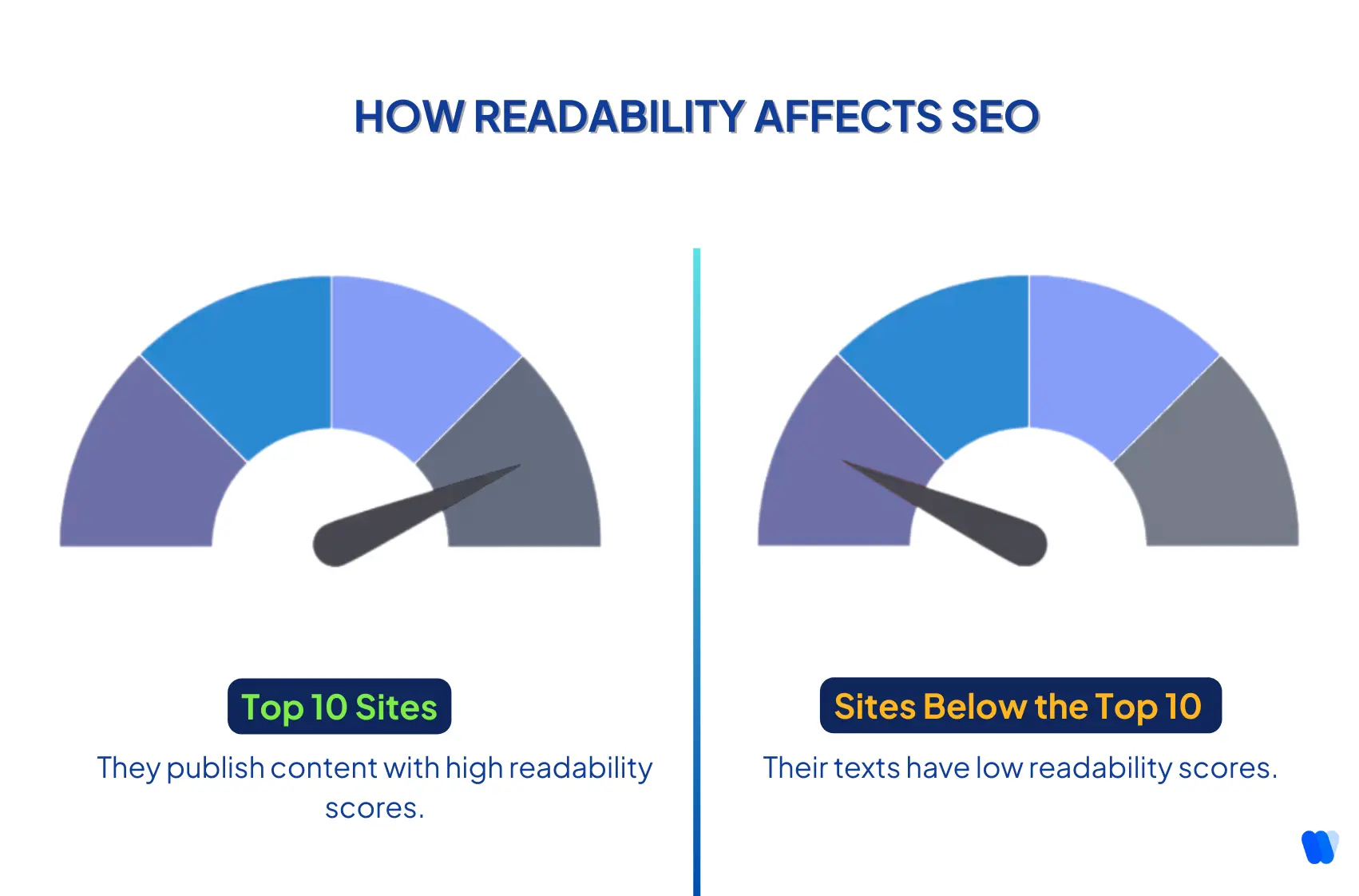
Is readability a ranking factor? Not directly, according to Google. But here’s what I do know:
● Clear, readable information resources enhances user experience and satisfies search intent faster.
● Well-structured posts (header tags, bullets, short paragraphs) improve scan-ability and parsing by search engines.
● Reading difficulty scores improve dwell time, reduce bounce rates, and boosts engagement, all of which influence SEO rankings.
● Naturally embedded keywords in readable text help with semantic search and topic relevance.
● Google prefers web page copy with a reading level between Grade 6–9 for featured snippets and voice search responses.
● Readable content increases accessibility, making it more inclusive for a global and diverse audience.
Bottom line? Write for the user, and the search engines will follow. Other visibility issues, like content cannibalization, can also hold back rankings when multiple pages compete for the same keyword.
As SEO evolves into answer engine visibility, GEO KPIs, like AI citation rates, content snippet extraction, and format alignment, are becoming just as important as traditional rankings and click-through rates.
What Are The Latest Readability Tools Available For Optimizing SEO Content?
Improving readability is one of the easiest ways to strengthen your SEO strategy. The latest readability tools SEO content writers use today are designed to make text more accessible, engaging, and search-friendly by analyzing structure, tone, and flow.
Semrush’s Readability Checker
Integrated within SEO Writing Assistant, Semrush offers a Flesch-Kincaid readability score and actionable guidance. It helps creators simplify complex sentences and enhance clarity, which is essential for effective content optimization.
Flexitools.io Content Readability Analyzer
Flexitools.io provides quick readability analysis using the Flesch-Kincaid, Gunning Fog, and SMOG Index formulas. It ensures privacy with local processing and helps writers identify dense or technical phrasing that reduces comprehension.
Yoast SEO Readability Analysis
A must-have WordPress plugin, Yoast checks passive voice, sentence length, and transition word usage in real time. This makes it ideal for bloggers and marketers who want to align with Google’s readability standards while maintaining a natural writing flow.
Readable.com
Readable.com combines readability scoring, grammar correction, and keyword density tracking. It’s among the best readability checker tools 2025 for writers aiming to balance SEO precision with an authentic, human tone.
AISEO
AISEO integrates AI-powered editing with the Hemingway Editor to simplify long sentences and adjust tone. It supports 26 languages and helps users refine clarity—making it one of the most practical tools enhancing readability for SEO in 2025.
By adopting these tools, writers and marketers can ensure their content is easier to read, ranks higher in search, and delivers a better experience to global audiences.
How Search Algorithms Process Content Readability Signals?
There’s a bit of a myth floating around that readability is a confirmed search engine ranking factor. While readability itself doesn’t directly affect SEO in terms of a measurable score impacting rankings, it plays a crucial role in user engagement. To better understand where readability fits, it helps to know what SERPs are and how they display content to users.
By focusing on content readability in SEO and overall readability improvement, you enhance user experience — resulting in stronger engagement metrics such as longer dwell time, lower bounce rates, and more meaningful interactions.
These metrics are signals search engines use to assess the quality of your content, ultimately helping to improve search engine visibility over time.
“From an SEO point of view, readability itself isn’t a direct ranking factor. We don’t try to figure out the reading level of the text on a page.”
Google has also mentioned explicitly that it doesn’t use readability scores like Flesch Reading Ease as direct ranking signals. But here’s the catch—it doesn’t have to.
“If you write content that’s hard to understand, then it’s going to be harder for people to stay and read. Lower user engagement can indirectly affect your ranking over time.”
Search engines rely on indirect signals to evaluate whether your content truly satisfies the user:
- Dwell time: How long someone stays on the page
- Bounce rate: Whether they leave immediately
- Pogo-sticking: When someone clicks your result, doesn’t find it helpful, and clicks back to try another
“Ultimately, content readability impacts user experience, and user experience is a signal Google cares about. Indirectly, readability can influence ranking.”
Poorly structured or overly complex content quickly triggers these negative signals. Google’s BERT (Bidirectional Encoder Representations from Transformers) and MUM (Multitask Unified Model) algorithms, are designed to better understand natural language; clarity, context, and intent are now more crucial than ever.
“It’s not about making your content overly simplistic; it’s about matching the reading level of your content to your audience’s expectations and needs.”
In short, SEO and readability go hand in hand. If users can’t follow your content, search engines won’t prioritize it because it’s simply not serving the user’s intent effectively. These readability methods align with generative engine optimization. AI models prioritize clear content for citations. These indirect readability signals connect to measurable metrics that search optimization specialists can ensure each piece can track and optimize systematically.
What Readability Metrics Drive SEO Success?
I’ve used multiple tools over the years, and while each offers slightly different features, the core readability signals remain consistent.
Here’s a breakdown of the main metrics you should care about:
| Metric | What It Measures | Ideal Range |
|---|---|---|
| Flesch Reading Ease | Sentence length + word syllables | 60–70 (general web) |
| Grade Level (Flesch-Kincaid) | U.S. school grades required to understand the content | 7th–9th grade |
| Average Sentence Length | Clarity through brevity | Under 20 words |
| Passive Voice Usage | More direct, engaging writing | Under 10% preferred |
| Subheading Frequency | Breaks up content into digestible parts | 1 per 300 words |
| Paragraph Length | Affects scannability, especially on mobile | 2–4 lines |
Most SEO readability checkers, such as Yoast, Screaming Frog, Sitebulb, and Semrush, include these metrics as part of their analysis. These tools help content teams identify clarity issues, improve structure, and meet best practices without relying on guesswork.
So, how important is readability to SEO? It’s incredibly important. Digital text assets that are easy to read and navigate keeps users engaged, reducing bounce rates and encouraging them to spend more time on your page.
This user engagement, in turn, sends positive signals to search engines, which prioritize content that aligns with user intent.
By tracking SEO readability alongside other on-page factors and How to Use AI to Find Content Gaps, SEO professionals can ensure each piece is both user-friendly and algorithm-aware. Readability measurement connects to content performance analytics. Engagement metrics validate optimization decisions across search and AI platforms.
While these readability metrics provide optimization targets, they work most effectively when integrated with broader technical SEO strategies.
How Readability Complements Technical SEO Elements?
You may wonder how readability SEO compares to traditional technical factors. The answer: they work best together. Here’s a comparison:
| SEO Factor | Purpose | How SEO Readability Complements It |
|---|---|---|
| Page Speed | Delivers content quickly | Ensures content is easy to consume once delivered |
| Mobile-Friendliness | Responsive layout | Prevents large text blocks from harming UX |
| Crawlability | Allows Google to access content | Clear content structure aids understanding |
| Structured Data | Enhances how content appears in SERPs | Clear content improves engagement after the click |
So while structured data gets the click, SEO readability keeps the user engaged. A subtle but critical part of optimizing for rankings and relevance.
What Data Shows The Correlation Between Readability And Organic Traffic?
Recent studies readability organic traffic correlation reveal that while readability alone may not directly determine rankings, it plays a crucial role in influencing engagement and visibility. Multiple research efforts have examined how text simplicity and structure affect SEO performance and user interaction.
Evidence Supporting A Positive Correlation
A study published in the Journal of Medical Internet Research analyzed diabetic retinopathy education sites and found that higher readability, measured by the Flesch-Kincaid Grade Level, correlated with stronger SEO metrics. More readable pages tended to appear earlier in search results, implying a link between better readability and improved visibility.
Studies Showing Limited Correlation
Conversely, Portent’s large-scale analysis of 750,000 content pieces across 30,000 desktop queries found no direct relationship between reading grade level and rankings. The report noted that top-performing pages often averaged an 11th-grade reading level, suggesting Google prioritizes context and relevance over readability score alone.
Similarly, Search Laboratory conducted controlled experiments creating content with varying readability scores. Their findings showed no consistent impact on ranking performance, indicating that readability supports engagement but isn’t a primary ranking factor.
Conclusion: Does Readability Affect SEO And Organic Traffic?
Overall, the consensus on does readability affect SEO organic traffic is that readability enhances engagement and dwell time, which indirectly benefits rankings. While it’s not an explicit algorithmic signal, improving readability contributes to stronger user experience, higher click-through rates, and greater organic traffic potential when combined with relevance and authority.
Why Content Structure Optimization Improves SEO Results?
Improving readability in SEO doesn’t require rewriting everything. Here’s what I look for when doing a content pass, especially when aiming to increase SEO readability score without sacrificing substance:
Sentence Structure Controls Reading Flow
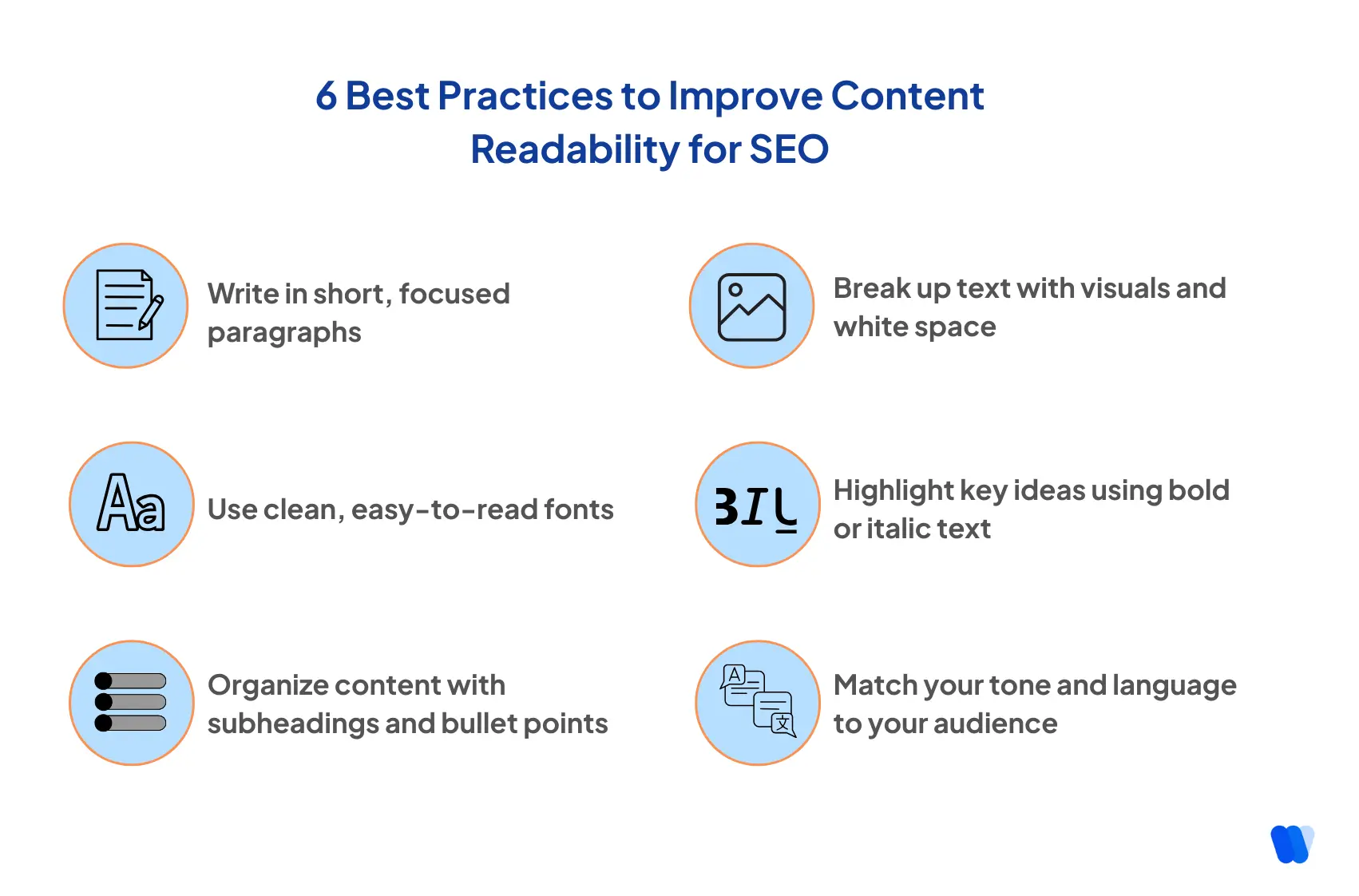
- Use short sentences—15–20 words max
- Keep paragraphs to 2–4 lines
- Mix up sentence lengths to improve rhythm
Word Selection Determines Content Clarity
- Prefer common words over jargon
- Avoid filler phrases and redundant modifiers
- Replace long words where simpler ones that work
Active Voice Construction Improves Engagement
- “We created the strategy” is clearer than “The strategy was created.”
Content Formatting Enhances Scannability
- Use subheadings to break content into sections
- Add bullet points or tables for clarity
- Highlight key takeaways or quotes
Visual Design Elements Support Content Accessibility
- Use legible font sizes
- Maintain enough line spacing
- Avoid large walls of text, especially on mobile
Beyond readability, Wellows the AI Search Visibility Platform for Startups helps teams turn structured, clear content into measurable visibility across both Google and AI search.
It bridges the gap between content optimization and brand discoverability ensuring every piece performs where users actually search.
These practices don’t just improve readability score, they make your content more effective across all stages of SEO and UX.
A detailed blog posting checklist. can help ensure structure, design, and SEO best practices are consistently applied.
If you’re scaling content across multiple formats or deadlines, here are 5 tips to triple content output using AI writing assistants that can help you produce high-quality drafts without compromising readability.
These optimization strategies support comprehensive SEO workflows. Content readability in SEO plays a vital role here — content clarity enhances both search visibility and AI comprehension.
What Are The Emerging Content Readability Standards For SEO 2025 Trends?
In 2025, emerging content readability standards for SEO 2025 trends emphasize clarity, accessibility, and authentic expertise.
Google continues refining how it evaluates text quality, rewarding content that balances technical accuracy with natural human readability. Below are the key trends shaping how creators and brands adapt their writing for better engagement and rankings.
1. Emphasis On E-E-A-T Principles
Google’s readability standards updates 2025 SEO revolve around E-E-A-T—Experience, Expertise, Authoritativeness, and Trustworthiness. Content that reflects real expertise and firsthand experience ranks higher, particularly in sensitive niches like finance, law, and healthcare. Adding author bios, verified credentials, and user testimonials strengthens credibility.
2. Integration Of AI-Powered Writing Tools
AI-assisted tools are now central to optimizing readability and tone. While AI handles structure and grammar, human editing ensures originality and emotional depth. Google’s evolving guidelines highlight that authentic, experience-driven content outperforms fully automated text.
3. Optimization For Voice Search
As voice search grows, creators must write in conversational tones and use natural language queries. Structuring posts with FAQs, short sentences, and localized keywords improves both user experience and voice visibility.
4. Adoption Of Long-Form Content
Long-form articles continue to dominate SEO because they build authority and context. However, structure matters—scannable sections, bullet points, visuals, and internal links enhance engagement while keeping readability high.
5. Focus On Readability And Accessibility
Content in 2025 must remain inclusive and accessible to wider audiences. Writing at a middle school level, minimizing jargon, and using shorter paragraphs improves understanding. Multimedia elements like videos or infographics increase accessibility and retention.
6. Personalization And Interactive Content
Personalized storytelling and interactive experiences—like polls, quizzes, and calculators—are becoming standard. These elements make information more engaging while supporting Google’s engagement-driven ranking metrics.
What Readability Metrics Matter For SEO 2025?
According to what readability metrics matter SEO 2025 sources, the most important indicators include Flesch-Kincaid Grade Level, average sentence length, passive voice ratio, and transition word usage. Together, these metrics measure how easy content is to digest—impacting bounce rate, dwell time, and search visibility.
By aligning with these standards, creators can achieve stronger SEO performance, better engagement, and lasting trust in the evolving landscape of digital publishing.
How Does Readability Impact SEO Engagement Metrics?
According to recent content readability user engagement study SEO ranking insights, the ease of reading directly influences how users interact with a page and how search engines interpret content quality. Readable content drives stronger engagement, lower bounce rates, and improved SEO performance.
Impact On User Engagement Metrics
- Bounce Rate: Complex or unclear text often causes readers to exit quickly, increasing bounce rates. Simple, well-structured writing keeps users engaged.
- Time On Page: Readable articles encourage visitors to stay longer and absorb more information, improving engagement quality.
- Pages Per Session: When content flows naturally, users are more likely to explore additional pages, raising session depth.
- Social Shares: Clear, concise posts are easier to share and more likely to attract new readers.
Content Readability Impact On SEO Rankings
Readability impact SEO engagement metrics by shaping behavioral signals that Google uses to assess quality. While readability isn’t a direct ranking factor, it strongly supports metrics that improve organic performance.
- Dwell Time: Easy-to-read, organized text encourages visitors to remain longer.
- Bounce Rate: Poorly structured content drives faster exits and weaker engagement.
- Session Duration: Engaging, readable layouts motivate users to browse more pages.
- Mobile Friendliness: Short sentences and proper formatting enhance readability and mobile SEO.
In conclusion, focusing on readability improves both user satisfaction and key SEO signals, helping your content perform better in search rankings.
Which Industries Lead In Readability SEO Strategies?
The industries implementing readability SEO strategies leading the way are those that understand how clarity and structure boost engagement and rankings. Media, SaaS, fintech, and e-commerce sectors are setting the standard by making their content more accessible and user-focused.
Media And Publishing
Media giants like the BBC and The Guardian serve as top case studies on readability SEO adoption by industry. The BBC uses concise headings and summaries to improve comprehension, while The Guardian integrates multimedia and internal links for higher reader engagement.
SaaS And Fintech
B2B SaaS and fintech brands embrace readability to enhance conversions and organic visibility. Agencies like Omnius and Embarque combine technical SEO with clear, audience-friendly writing to sustain long-term growth.
E-Commerce
E-commerce leaders use readability-focused content to simplify buying journeys and improve SEO. Product descriptions and guides emphasize clarity, helping distribute link equity across pages.
Healthcare, Finance, And News
When assessing which sectors focus on readability SEO healthcare finance news, these industries show leadership by balancing accuracy with simplicity. Healthcare and finance sites reduce jargon for trust and compliance, while news outlets prioritize easy scanning and storytelling for reader retention.
Ultimately, these sectors prove that prioritizing readability not only elevates user experience but also reinforces long-term SEO performance and credibility.
FAQs
Break up long sentences, use active voice, and keep paragraphs short (2–4 lines). Add subheadings, bullet points, and visuals for scannability. Replace jargon with clear language to make content more accessible to both users and search engines.
Readable content reduces cognitive load, improves mobile scanning, and aligns with how modern search and AI systems measure usefulness. Clear content keeps users engaged longer, sending positive signals to search engines.
While not a direct ranking factor, readability improves engagement metrics like dwell time and bounce rate. Pages that are easier to read satisfy intent faster, making them more likely to appear in featured snippets and maintain strong visibility.
Use short sentences (15–20 words), simple vocabulary, and active voice. Structure content with headings, lists, and visuals. Keep paragraphs concise and ensure smooth flow from one idea to the next.
Content readability in SEO is the ease with which users can consume and understand a page. It covers sentence structure, vocabulary choice, formatting, and overall flow, ensuring content works for both readers and search engines.
Readability is commonly measured using metrics like Flesch Reading Ease, Flesch–Kincaid Grade Level, average sentence length, passive voice percentage, and subheading frequency. These metrics align with user comprehension and scannability.
Not as a standalone ranking factor. However, readability indirectly influences SEO through engagement signals—time on page, pogo-sticking, and bounce rates—that search engines use to assess content quality.
Read More Articles
If you’re focused on elevating your content game, here are some related reads:
Conclusion
It’s easy to overlook readability when you’re deep in sitemaps, meta tags, and Core Web Vitals. But in my experience, the content that performs best is the content that’s understood quickly, clearly, and confidently.
Optimizing for content readability in SEO doesn’t mean watering things down. It means respecting your reader’s time, aligning your message with their intent, and making your content accessible across devices and attention spans.
With AI tools for SEO, improving readability becomes part of your standard SEO process, not a separate task. That alignment is where SEO starts working smarter, not just harder.