KIVA’s Keyword Clustering turns raw keyword lists into AI-ready clusters—so every topic aligns with real search intent and LLM logic.
Keyword Clustering, a KIVA feature, groups semantically similar queries around a seed keyword to mirror how users and large language models interpret topics. Unlike fragmented keyword targeting, KIVA by Wellows, an AI SEO Agent, connects search behavior, Gemini, Claude, ChatGPT, DeepSeek and contextual planning—helping autonomous marketers build structured, intent-driven content strategies.
What is Keyword Clustering?
Keyword Clustering is an advanced SEO approach that groups related queries into topical clusters, using AI to reflect how search engines and large language models interpret user intent. This method helps autonomous marketers create content blueprints that address multiple search queries within a single piece, making content more relevant and efficient.
With the KIVA AI keyword clustering feature, you can input a seed keyword and instantly see related clusters, mapped with context themes. This process improves LLM visibility (Gemini, Claude, ChatGPT, and DeepSeek) and reduces content fragmentation—so instead of creating dozens of disconnected articles, your team builds fewer, richer, and more authoritative pages.
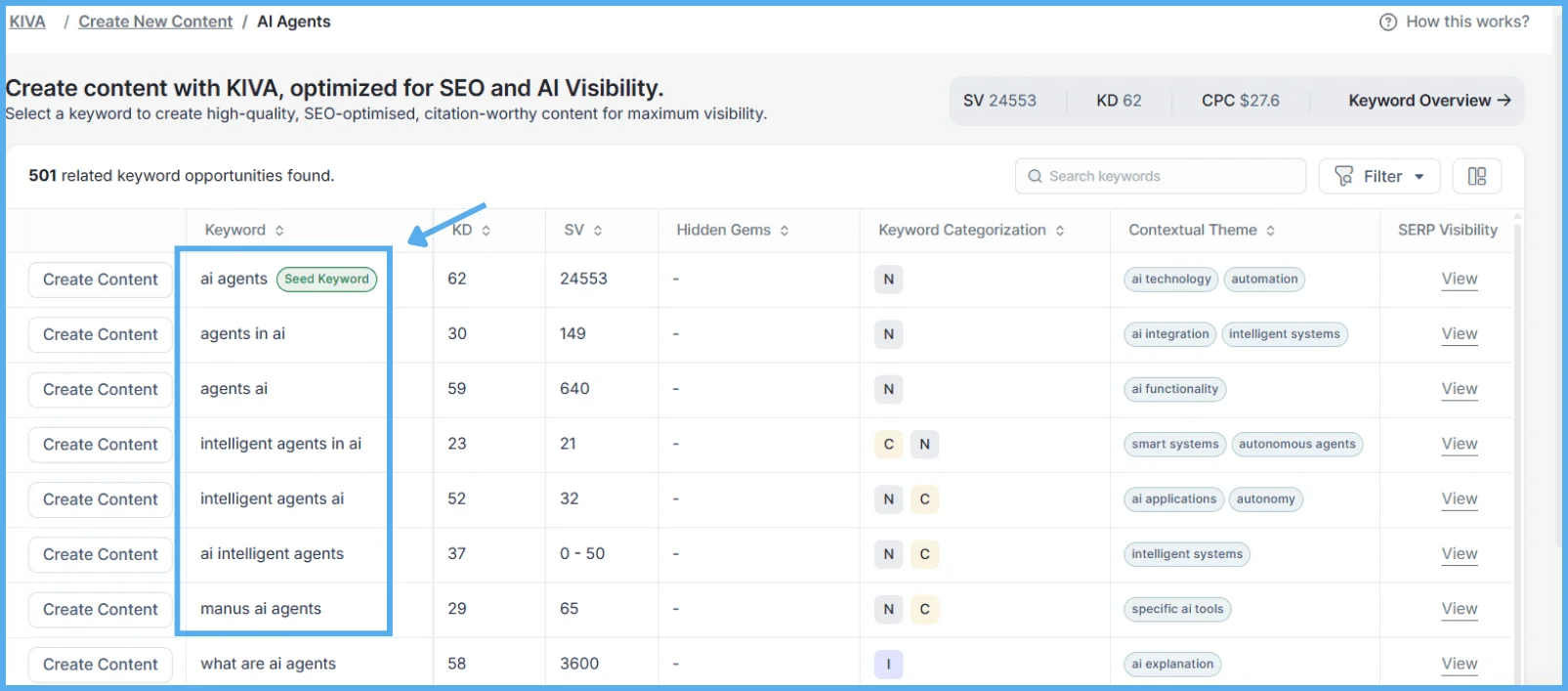
- Seed Keyword: The root term that unlocks clustering insights and thematic structure (e.g., “AI agents”).
- Keyword Clusters: AI-defined groups of terms that reflect shared intent and natural phrasing behavior.
- Contextual Themes: Topic layers LLMs use to relate content—such as “automation workflows” or “natural language systems.”
Why is Keyword Clustering Important for AI-First Content?
Keyword clustering helps marketers and SEO teams align with how both users and large language models (LLMs) interpret topics. With KIVA by Wellows, this process goes beyond keyword lists, creating structured frameworks that power scalable, AI-first content strategies.
Enhanced Content Relevance
By grouping related keywords into clusters, KIVA enables you to create in-depth content that fully addresses a topic. This makes your pages more relevant and ensures readers get meaningful insights in one place.
Improved SEO Performance
Clustering keywords helps search engines recognize the relationships between queries and topics. As a result, your content can achieve stronger visibility across multiple search terms, boosting organic reach.
Better User Experience
Well-structured clusters reduce redundancy and provide readers with comprehensive answers in fewer pages. This creates a smoother navigation journey and higher engagement.
Intent-Driven Grouping
KIVA organizes keywords by meaning and context rather than raw volume, ensuring your content aligns more closely with actual search intent and LLM interpretation.
Deeper Content Assets
Instead of scattering effort across thin articles, clustering builds fewer but more substantial pages that mirror how tools like Gemini, Claude, DeepSeek and ChatGPT surface results.
Semantic Maps
KIVA connects clusters into topic-wide frameworks, strengthening topical authority and improving both SERP performance and LLM discoverability.
By moving beyond isolated keywords into structured knowledge frameworks, KIVA enables autonomous marketers to achieve stronger SERP visibility and consistent alignment with AI-driven search.
How Does KIVA Keyword Clustering Works?
KIVA uses a seed keyword to generate a list of related terms—grouped by meaning, intent, and real search behavior. This helps you create focused, high-impact content around a complete topic.
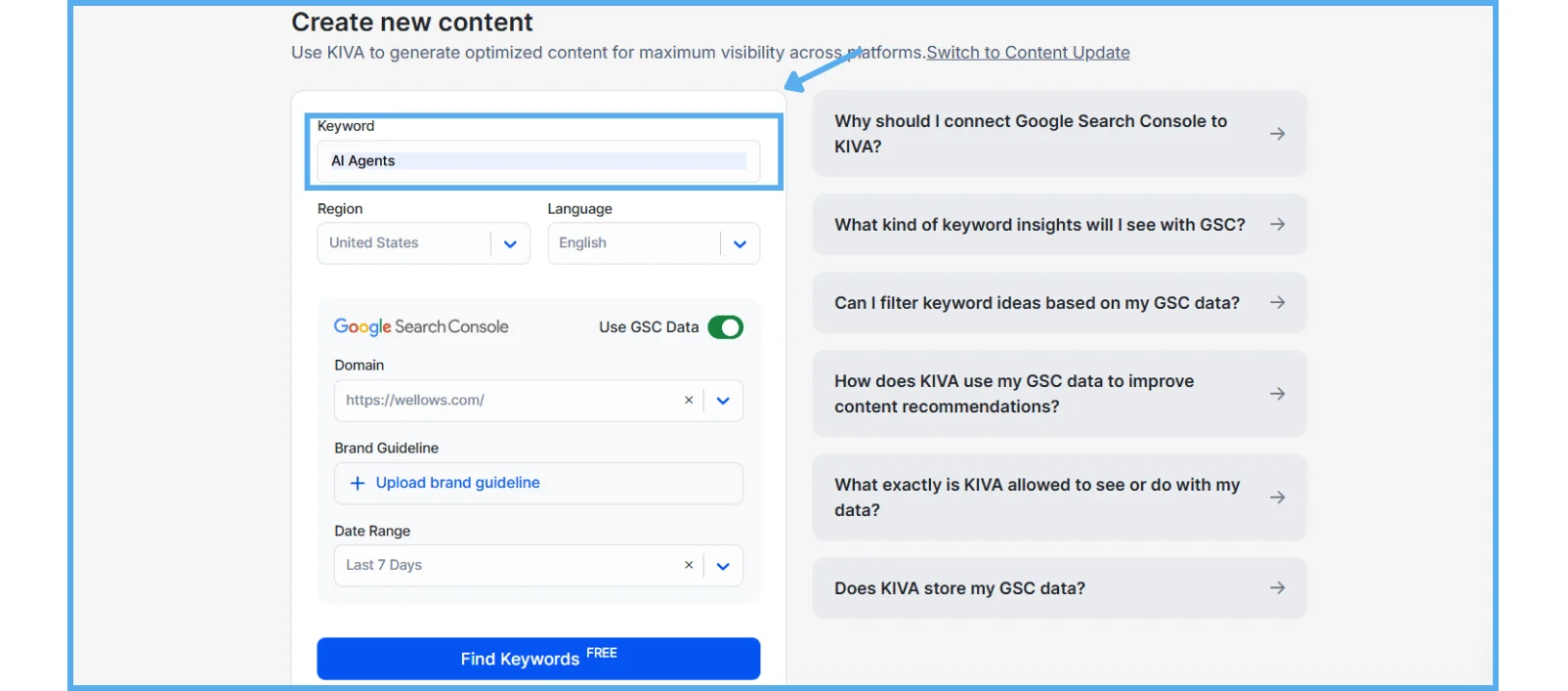
1. Seed Keyword: The Starting Point
The Seed Keyword is the initial term you input into KIVA—such as “AI agents.” This keyword serves as the foundation for KIVA to generate a comprehensive list of related search terms, helping you explore various facets of the topic and understand how users are searching for it.
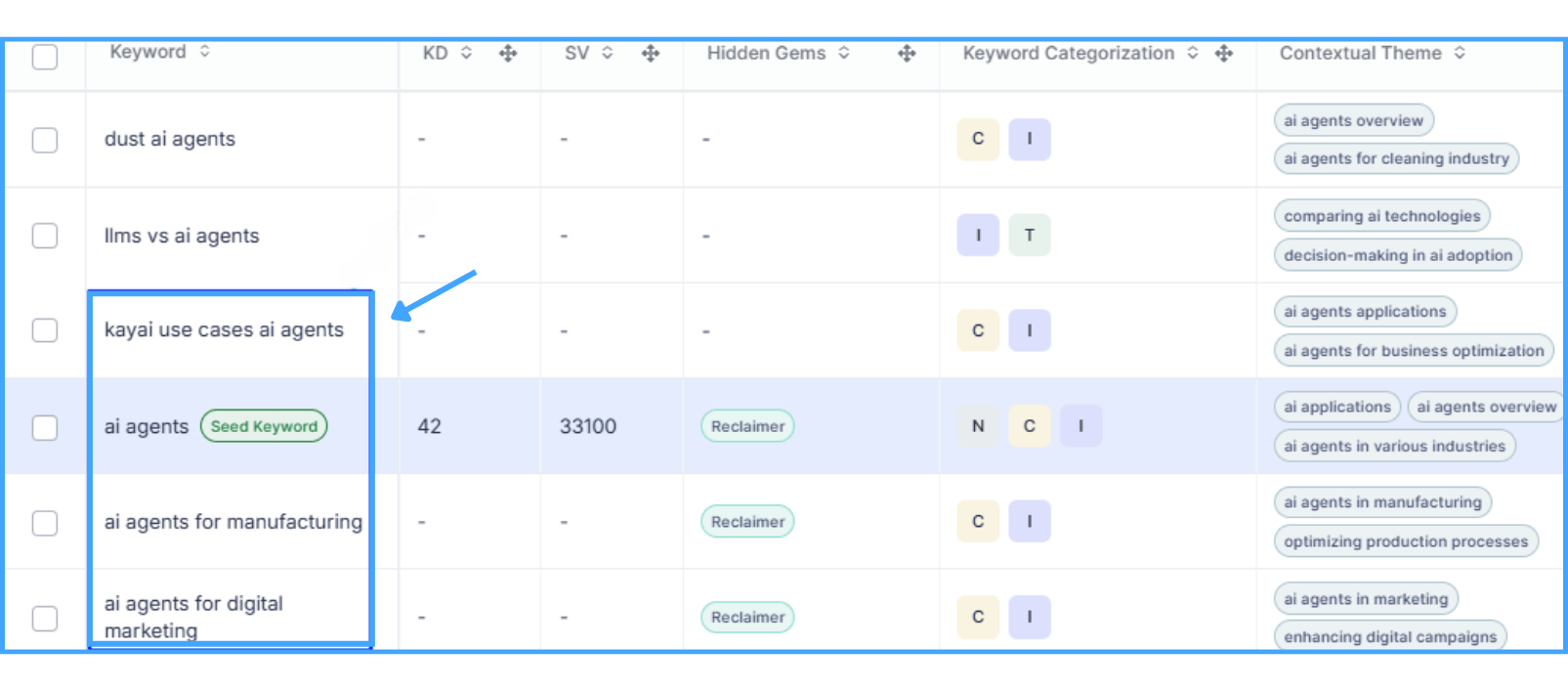
2. Keyword Clusters: Organized Groups of Related Terms
KIVA Keyword Clusters are groups of semantically related search terms that KIVA organizes based on user intent and search behavior. Grouping these keywords it enables you to identify which terms can be addressed together in a single piece of content, streamlining your content creation process and enhancing topical relevance.
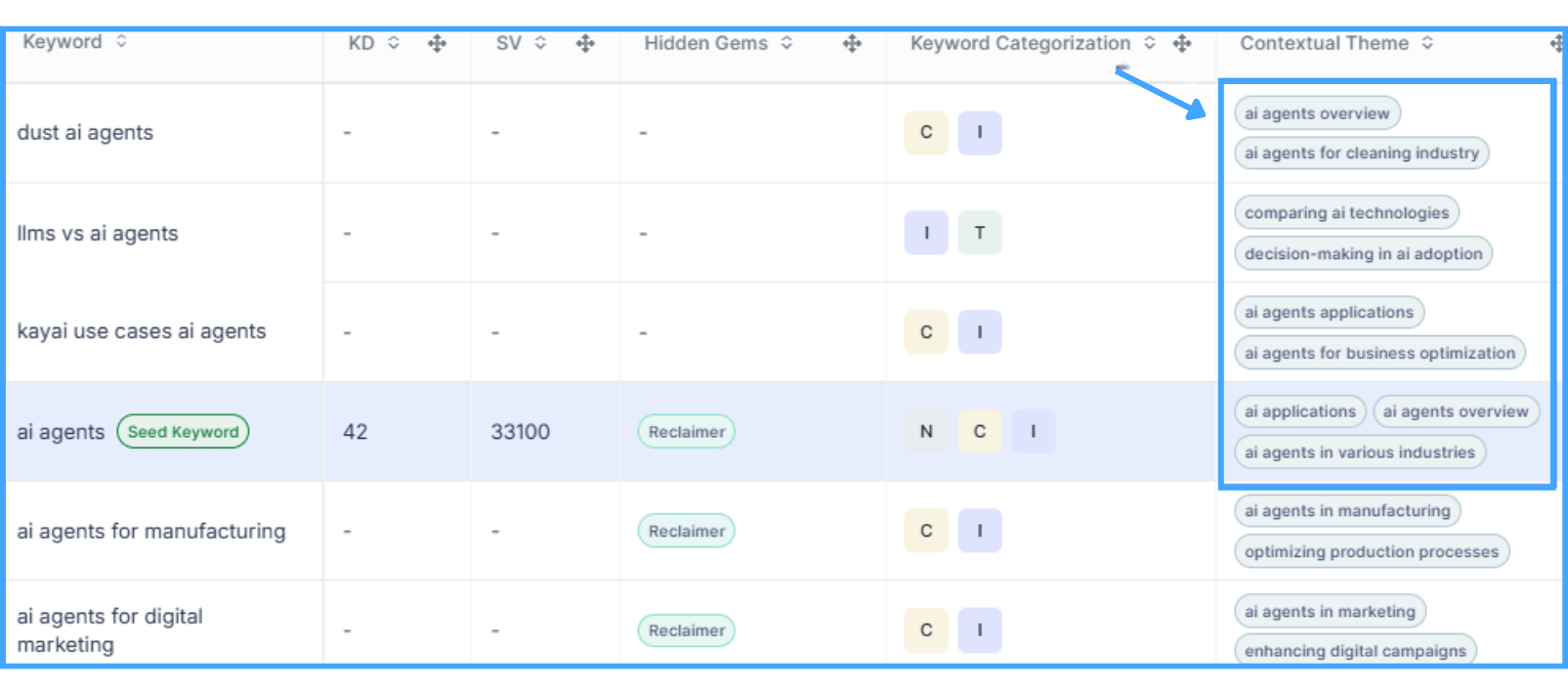
3. Contextual Themes: Understanding User Intent
These themes serve as a layer of user intent analysis, helping uncover the underlying goals behind search queries. By understanding what users are truly trying to achieve, you can create content that not only targets the right keywords but also aligns with their needs, expectations, and decision-making journey.
How Does Keyword Clustering Benefit SEO?
KIVA Keyword Clustering benefits SEO by grouping semantically related search terms into structured topics. This enables marketers to create comprehensive, intent-driven content that aligns with user needs, prevents keyword overlap, and improves visibility across search engines.
| Feature & Process | Without Clustering | With KIVA’s Keyword Clustering | Benefits |
|---|---|---|---|
| Content Relevance | Pages are built around isolated keywords, missing broader topic context | Clusters group related terms into thematic content structures | 150%+ improvement Content is more comprehensive and aligned with user intent, improving SEO and user experience. |
| Search Visibility | Ranking efforts focus on single terms, limiting visibility | Clusters optimize pages for multiple related queries simultaneously | Improved search rankings Pages rank for a wider set of terms, boosting organic traffic potential. |
| Keyword Cannibalization | Multiple pages compete for the same keywords and dilute authority | Clusters assign distinct keyword groups to dedicated pages | Prevents cannibalization Each page builds unique authority without internal competition. |
| Content Gaps | Opportunities are missed as keyword lists don’t show uncovered themes | Clusters reveal unaddressed topics and subtopics for new content | Identifies content gaps Teams spot missing opportunities and strengthen topical coverage. |
| Content Workflow | Writers manually create briefs without semantic context | Seed keywords generate automated clusters with context themes | Streamlined creation Saves 70+ hours/month in research and brief creation, while producing higher-quality content. |
KIVA’s clustering engine turns keyword lists into topic-driven strategies—so every page hits deeper and ranks faster.
KIVA Makes Keyword Clustering Smarter for All Marketers
KIVA’s Keyword Clustering feature groups search terms based on semantic meaning and real user intent—creating topic-aligned strategies that reflect how LLMs interpret and connect ideas. It’s built for autonomous workflows and designed to maximize LLM visibility from the first draft.
1. Agencies: Bring Scale and Semantic Clarity to SEO
Agencies need to deliver high-volume briefs without sacrificing depth. With KIVA, every keyword map becomes a complete topic structure—ready for handoff and tuned for AI-generated search outputs.
| The Challenges | How KIVA Helps Agencies |
|---|---|
| Keyword Chaos: Lists are long but lack thematic cohesion. Slow Turnaround: Manual grouping and mapping slows delivery. |
AI-Aligned Clusters: Automatically group keywords based on LLM-recognized intent. Brief Sync: Push clusters into structured briefs instantly—no extra tools. |
Agencies using KIVA Keyword Clustering report faster approvals and improved semantic depth in client briefs.
Want to scale SEO briefs without losing structure? See how the AI search visibility platform for agencies brings semantic precision to every plan.
2. Startups: Go From One Keyword to Full Strategy
Startups can’t afford fragmented efforts. KIVA turns one seed term into full-funnel coverage—surfacing real-world themes that improve your content’s LLM visibility and reduce rewrite loops.
| The Challenges | How KIVA Helps Startups |
|---|---|
| Thin Content: Single keywords lead to shallow drafts. Manual Planning: No visibility into what topics LLMs understand. |
Cluster-to-Draft Flow: Seed terms create AI-tuned outlines fast. LLM Theme Mapping: Use contextual clusters to match model expectations. |
Startups using Wellows Keyword Clustering achieve faster go-to-market cycles and stronger visibility across AI-led SERPs.
See how Wellows, the AI Search Visibility Platform for Startups, helps teams scale smarter and grow visibility faster →
3. Freelancers: Build Smarter Plans Without Extra Tools
Freelancers need to deliver clear, optimized plans fast—without the overhead. KIVA’s clustering tool creates intent-rich groups that make your work LLM-friendly and easy for clients to approve. With the AI Search Visibility Platform for Freelancers, independent marketers can turn scattered client inputs into cohesive, data-backed SEO strategies that scale effortlessly.
| The Challenges | How KIVA Helps Freelancers |
|---|---|
| Scattered Inputs: Clients send random terms with no structure. Format Fatigue: Briefing templates take too long to populate. |
AI-Semantic Clusters: Organize keywords to match how LLMs group ideas. One-Click Brief Sync: Export strategy into usable outlines fast. |
Freelancers report saving 70+ hours per month by using KIVA Keyword Clustering to streamline client deliverables.
See how KIVA helps Freelancers →
4. Marketing Consultants: Build Authority-First Plans Backed by AI Patterns
Consultants need to present sharp strategies that align with both brand tone and AI systems. KIVA’s keyword clustering brings clarity and model-aligned structure to every proposal.
| The Challenges | How KIVA Helps Consultants |
|---|---|
| Misaligned Structure: Keyword plans don’t reflect how AI organizes topics. Client Trust Gaps: Recommendations feel generic or disconnected. |
Model-Informed Strategy: Clusters are shaped by how LLMs connect and surface topics. Client-Ready Clarity: Turn research into structured insights that build authority and trust. |
Consultants using KIVA Keyword Clustering gain stronger client trust by showing AI-backed topic structures in proposals.
Want to move from keyword chaos to clarity? Discover how the AI search visibility platform for consultants helps you build data-backed strategies that earn authority.
What KIVA’s Keyword Clustering Output Reveals
Group keywords by meaning and user intent—not just volume—to build smarter content strategies with clearer topical coverage.
Clustering in Action
KIVA’s clustering engine takes a single seed keyword and returns smart, structured groups that reflect how users search and how LLMs interpret content.
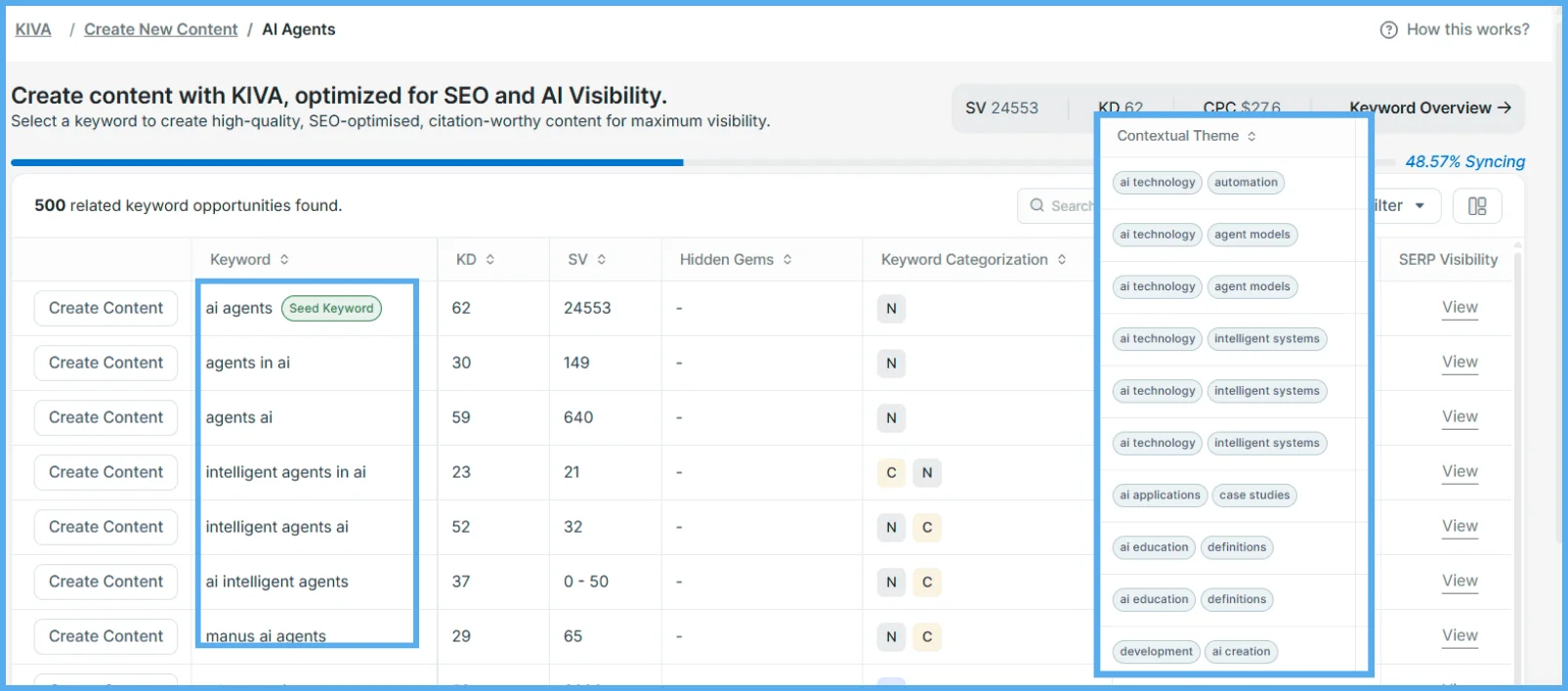
- Seed-Based Expansion: Input one keyword and get dozens of semantically linked phrases.
- Intent-Grouped Clusters: Organizes related terms based on user behavior and search logic.
- Contextual Themes: Automatically identifies topic buckets to guide structure and outlines.
- Brief Builder Sync: Push clusters directly into content briefs and outlines.
Explore Related Features That Strengthen Topic Coverage
Use Keyword Clustering with other KIVA tools to drive deeper topical breadth:
Helpful Tools to Maximize Clustering Output
Turn clustered keywords into actionable content strategy using these checklists:
- Keyword Research Checklist – Prioritize clusters that align with search demand and journey stages.
- LLM Pattern Recognition Checklist – Match your content to how LLMs interpret and score topical groupings.
These resources help your team turn raw keyword data into structured, search-ready strategy.
Recap: Why KIVA’s Clustering Engine Improves SEO Planning
KIVA by Wellows, an AI SEO Agent, transforms raw keyword lists into structured semantic clusters—making briefs, outlines, and drafts AI-ready from the start.
- Expand from one Seed Keyword into full topic clusters
- Map clusters to user intent, SERP signals, and LLM logic (Gemini, Claude, ChatGPT, DeepSeek)
- Prevent content cannibalization by grouping similar terms smartly
- Write context-rich, entity-driven content instead of isolated keywords
Agencies, startups, freelancers, and consultants using KIVA Keyword Clustering report faster briefs, stronger topical coverage, and AI-aligned visibility.
FAQs
KIVA’s Keyword Clustering groups related search terms into semantic clusters. This creates intent-driven content aligned with how users and LLMs (Gemini, Claude, ChatGPT, DeepSeek) interpret topics, boosting visibility and reducing overlap.
Keyword clusters in KIVA are groups of semantically similar terms built around a Seed Keyword. They reflect how LLMs and search engines organize intent, ensuring strategies align with user journeys.
Yes, keyword clustering can significantly improve content organization. By grouping related keywords into clusters, KIVA helps create structured content strategies that enhance user experience and strengthen SEO performance.
Benefits include time savings, reduced redundancy, and improved LLM visibility. Clustering helps agencies, startups, freelancers, and consultants create fewer but richer articles.
Yes, keyword clustering can effectively prevent keyword cannibalization by organizing related keywords into distinct groups, ensuring each page targets a unique set of terms and search intents. With KIVA, this process is automated, reducing overlap and improving overall SEO performance.
KIVA Keyword clustering is an SEO feature that groups related keywords to boost content relevance and search visibility. The main types include SERP-based clustering, which analyzes overlapping search results and can be soft, moderate, or hard; semantic clustering, which uses NLP and AI to connect keywords by meaning and intent; and pattern-based clustering, which organizes keywords by shared stems or structures. Together, these methods help create structured, intent-driven SEO strategies.
KIVA analyzes a Seed Keyword, groups semantically linked terms, and detects Contextual Themes. It then maps these clusters into briefs automatically, eliminating manual sorting.