KIVA’s LSI feature extracts semantic terms from Google and Bing—helping content align with SEO signals and LLMs like ChatGPT, Claude, Gemini, and DeepSeek.
LSI is part of KIVA’s features, the autonomous SEO engine by Wellows. It integrates semantic clustering, schema mapping, readability scoring, and citation analysis. These insights feed into the Content Brief Generator—and are then carried forward into the content KIVA creates, ensuring every draft is SEO-ready, LLM-friendly, and built with richer structure and stronger topical alignment.
What is Latent Semantic Indexing (LSI)?
Latent Semantic Indexing (LSI), also known as Latent Semantic Analysis (LSA), is a mathematical technique developed in the 1980s for natural language processing and information retrieval. It identifies patterns in the relationships between terms and concepts within a body of text. By analyzing these relationships, LSI captures the underlying semantic structure of data, enabling more effective information retrieval and text analysis.
Building on these principles, the KIVA LSI feature works as an autonomous semantic layer. Instead of relying on static keyword lists, it collects semantically related phrases directly from live Google and Bing signals. These are surfaced as dynamic semantic variants that:
- Improve keyword coverage
- Optimize briefs
- Align content with both human search behavior and modern LLMs like Claude, Gemini, ChatGPT, and DeepSeek
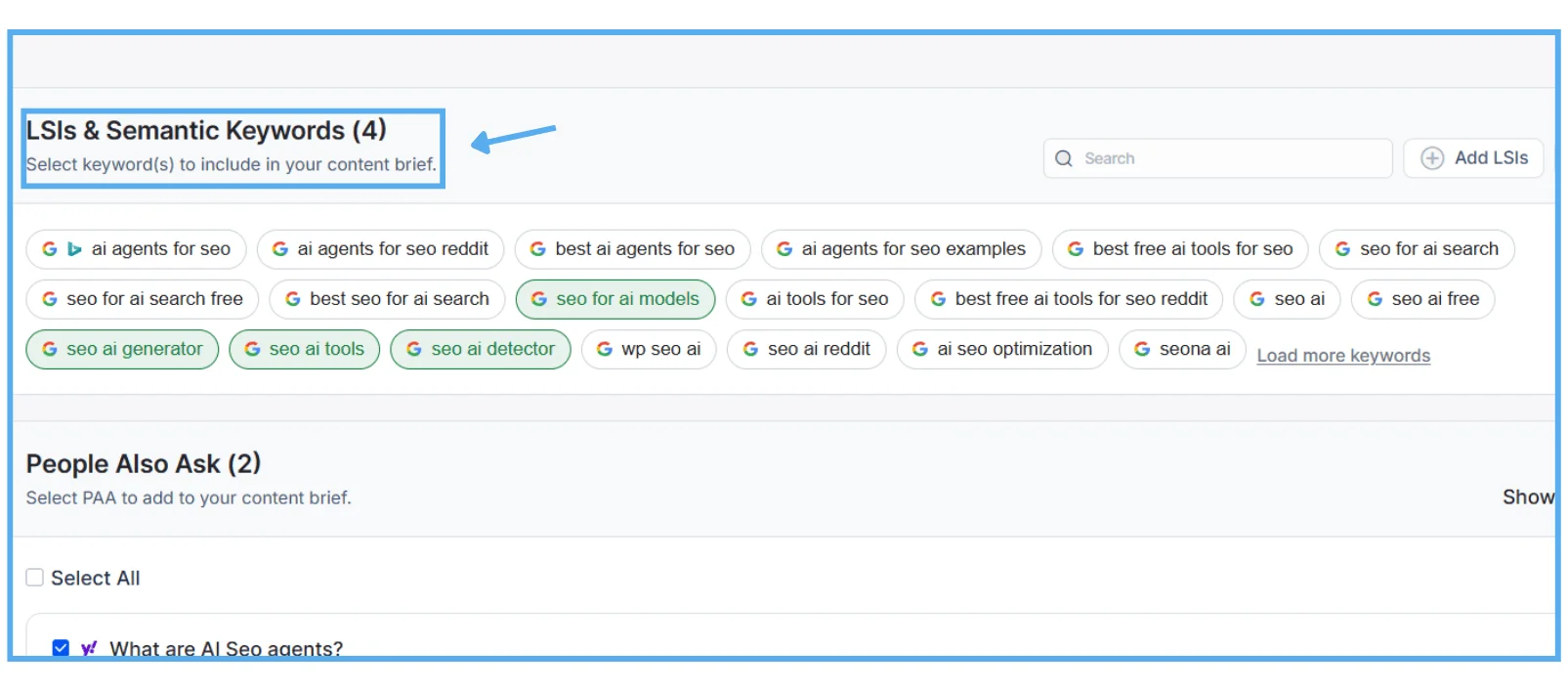
These insights feed directly into the Content Brief Generator, allowing marketers to build AI-aware outlines. The system ensures that LSI signals not only support SEO but also reinforce LLM prompt structuring and visibility across engines like Claude, Gemini, and DeepSeek.
- LSI keywords are semantically linked to your main term, drawn from real-time search trends.
- They expand reach by surfacing variations relevant to both searchers and language models.
- They boost content depth and reduce keyword stuffing by naturally increasing topical breadth.
- They help Google and LLMs understand context, improving ranking and citation alignment.
Try LSI Keyword Suggestions Free
Why LSI Keywords Are Important?
Latent Semantic Indexing (LSI) keywords are terms and phrases that are semantically related to a primary keyword, providing context and depth to content. For example, in an article about “apple,” LSI keywords could include “fruit,” “orchard,” and “health benefits” if discussing the fruit, or “technology,” “iPhone,” and “MacBook” if referring to the company.
While the term “LSI keywords” is common in SEO discussions, Google has made it clear that it does not use LSI technology in its algorithms. Instead, it employs advanced natural language processing models (like BERT and MUM) to understand context and intent. However, the practice of including semantically related terms remains highly valuable for creating relevant, comprehensive content.
Incorporating these terms improves readability, enhances user experience, and helps search engines and AI systems interpret your page more accurately—leading to stronger visibility and organic traffic.
KIVA takes this further with its AI SEO Agent. Its LSI engine automatically extracts semantically related terms from live Google and Bing signals and applies them to content briefs and outlines. This allows teams to:
- Uncover deep topic associations for Google and large language models
- Embed LSI insights directly into briefs for structured, AI-ready outlines
- Align content patterns with Claude, Gemini, ChatGPT, and other LLMs
With KIVA, LSI keywords aren’t just SEO add-ons—they become part of a strategy that bridges human search behavior with AI-driven visibility.
How Does LSI Work?
Latent Semantic Indexing (LSI) works through a series of mathematical steps designed to uncover hidden relationships between words and documents:
- Constructing the Term-Document Matrix: LSI starts by creating a matrix where each row represents a unique term, each column represents a document, and each cell indicates how often a term appears in a document.
- Applying Singular Value Decomposition (SVD): This matrix is then decomposed into three smaller matrices using SVD, which reduces complexity while preserving key patterns.
- Reducing Dimensionality: By retaining only the top k singular values, LSI filters out noise and emphasizes the strongest term-document relationships.
- Mapping Terms and Documents: In this reduced space, both terms and documents are mapped as vectors, making it possible to identify semantic similarity and contextual meaning beyond exact word matches.
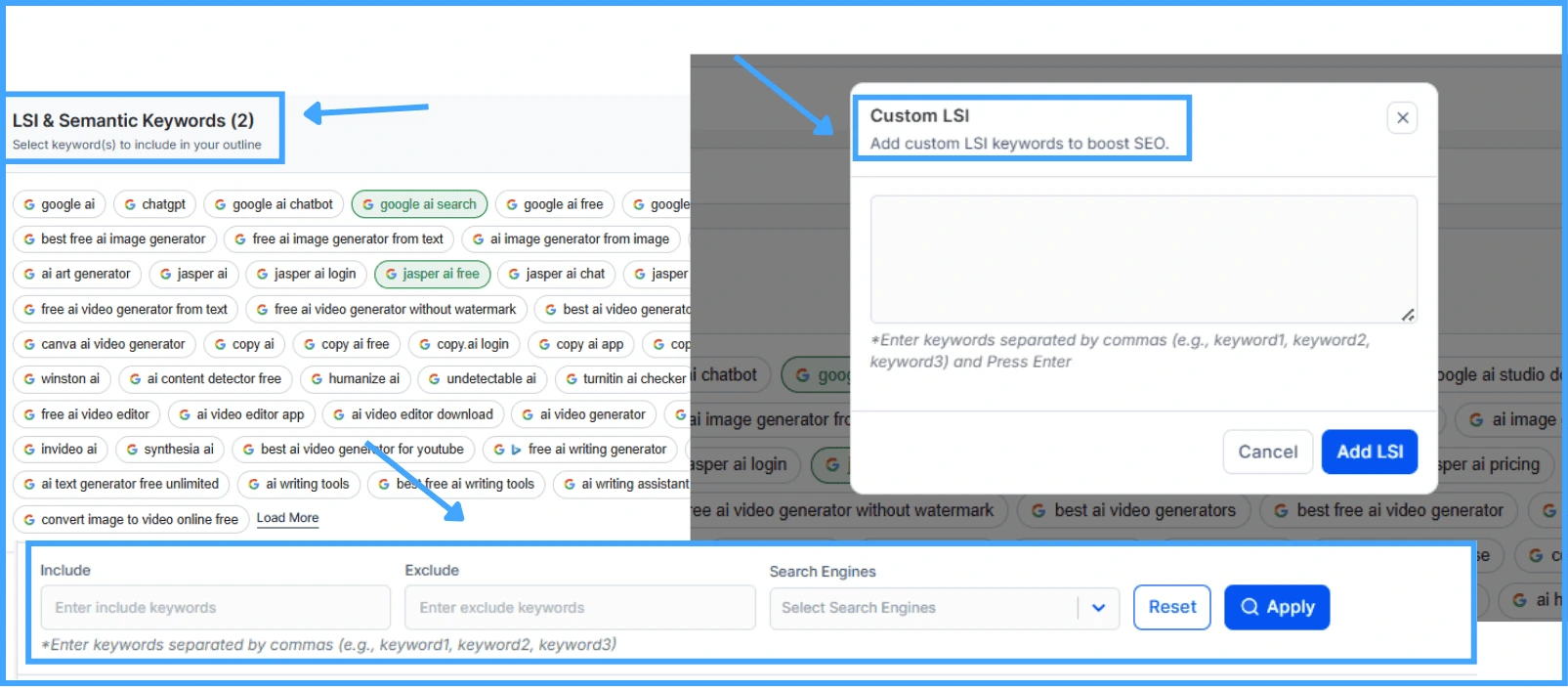
The LSI & Semantic Keywords panel in KIVA AI SEO Agent applies these principles in a user-friendly way to help you discover and apply contextually relevant terms that deepen your content’s topical authority. Follow these steps to enhance semantic alignment from the ground up:
1. Discover Related Keywords
KIVA automatically surfaces LSI and semantic keyword suggestions based on your primary topic using search data from Google and Bing.
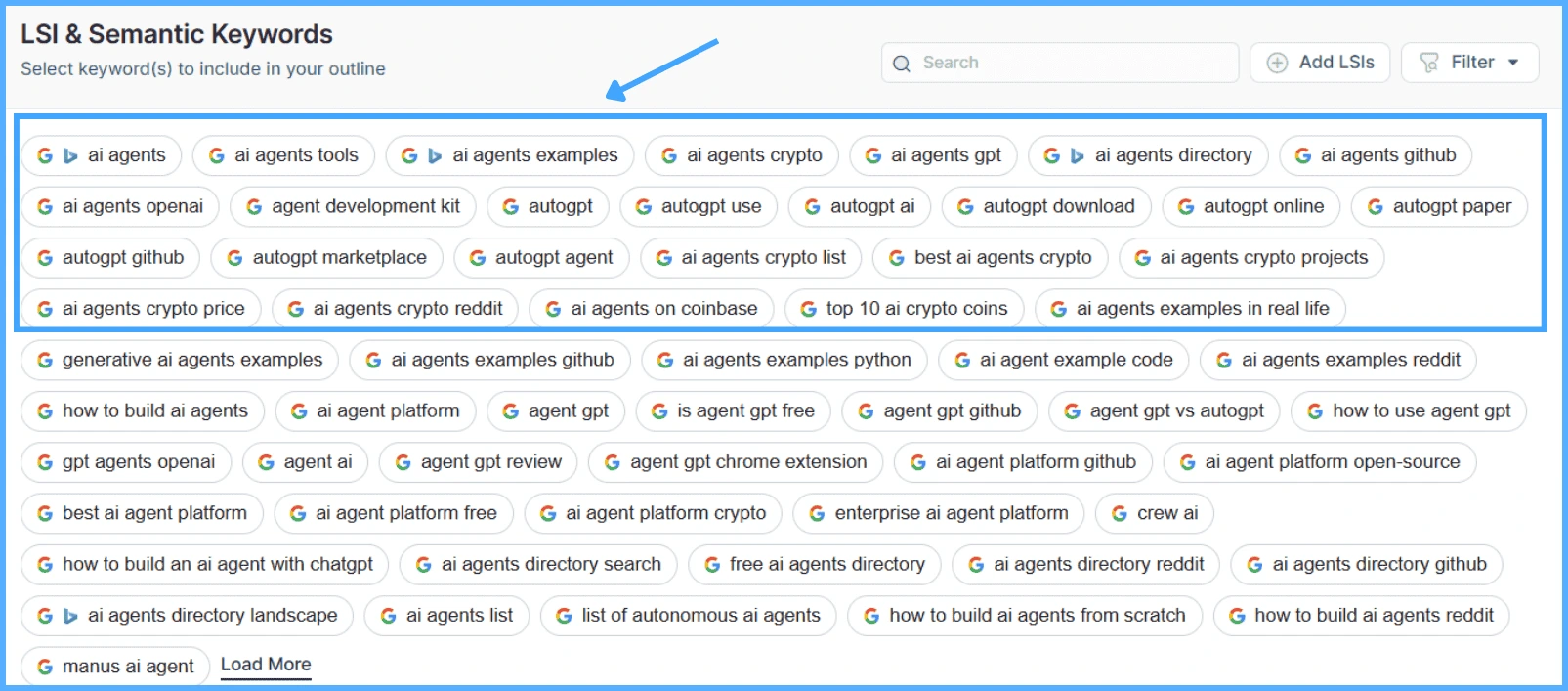
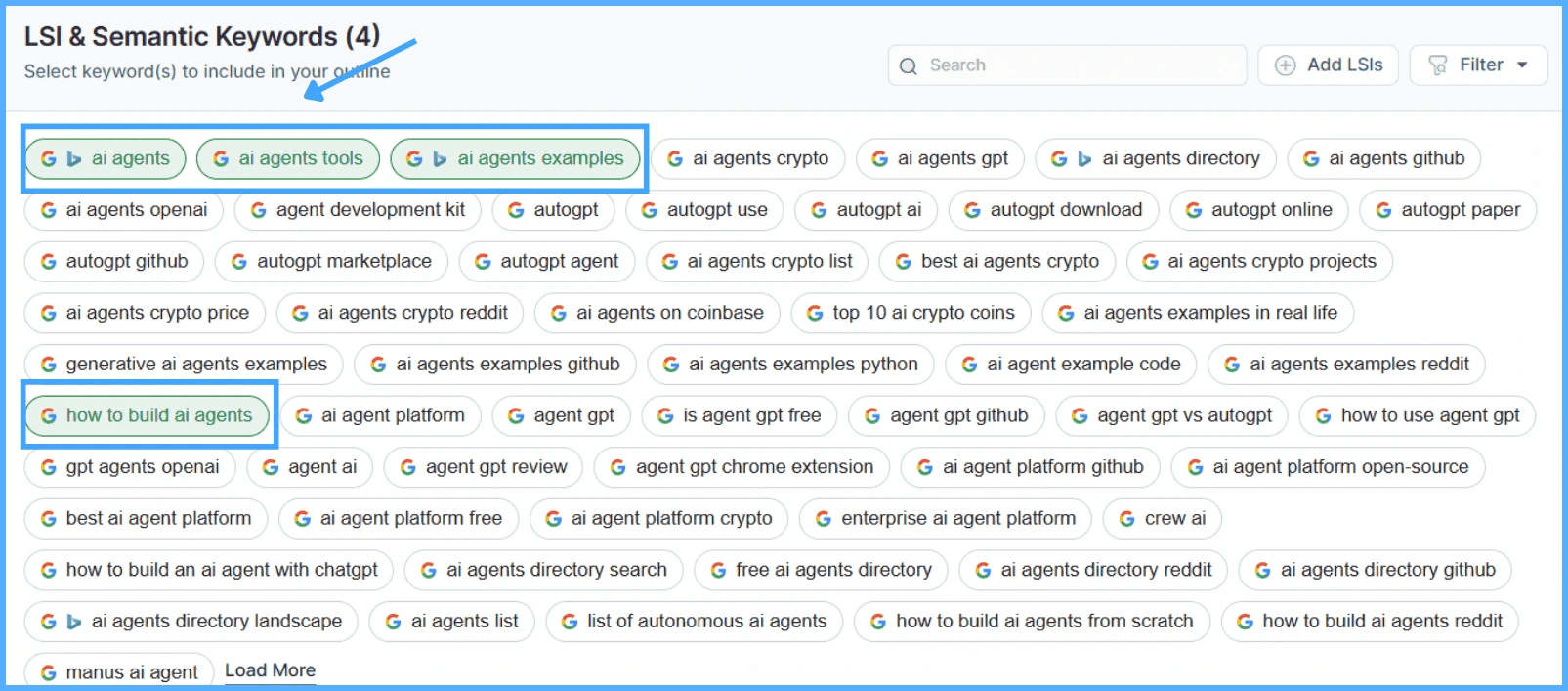
2. Select Keywords
Click on keyword tags to add them to your outline. This increases semantic coverage and reinforces topical relevance.
3. Use the Filter Panel
Refine keyword suggestions by selecting specific search engines, or including/excluding terms based on your focus.
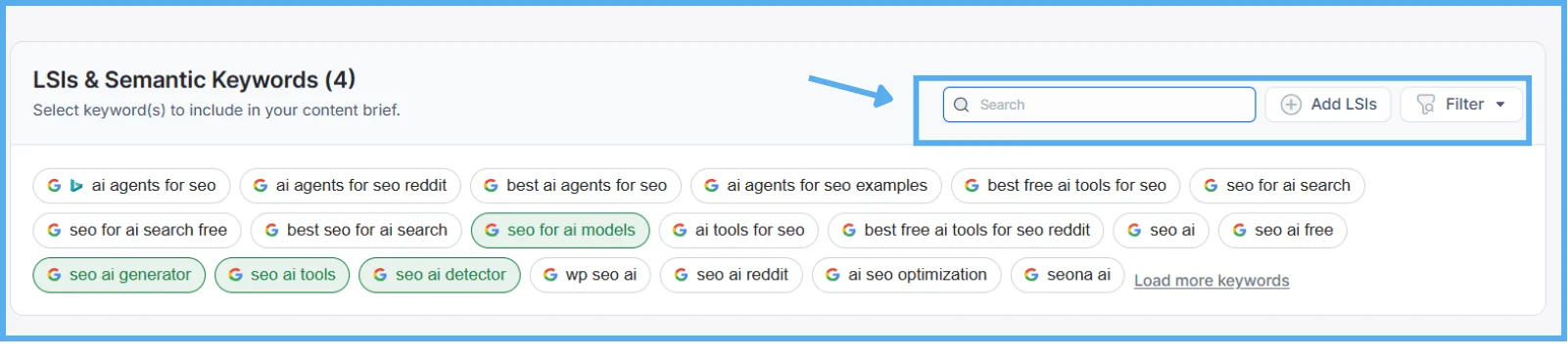
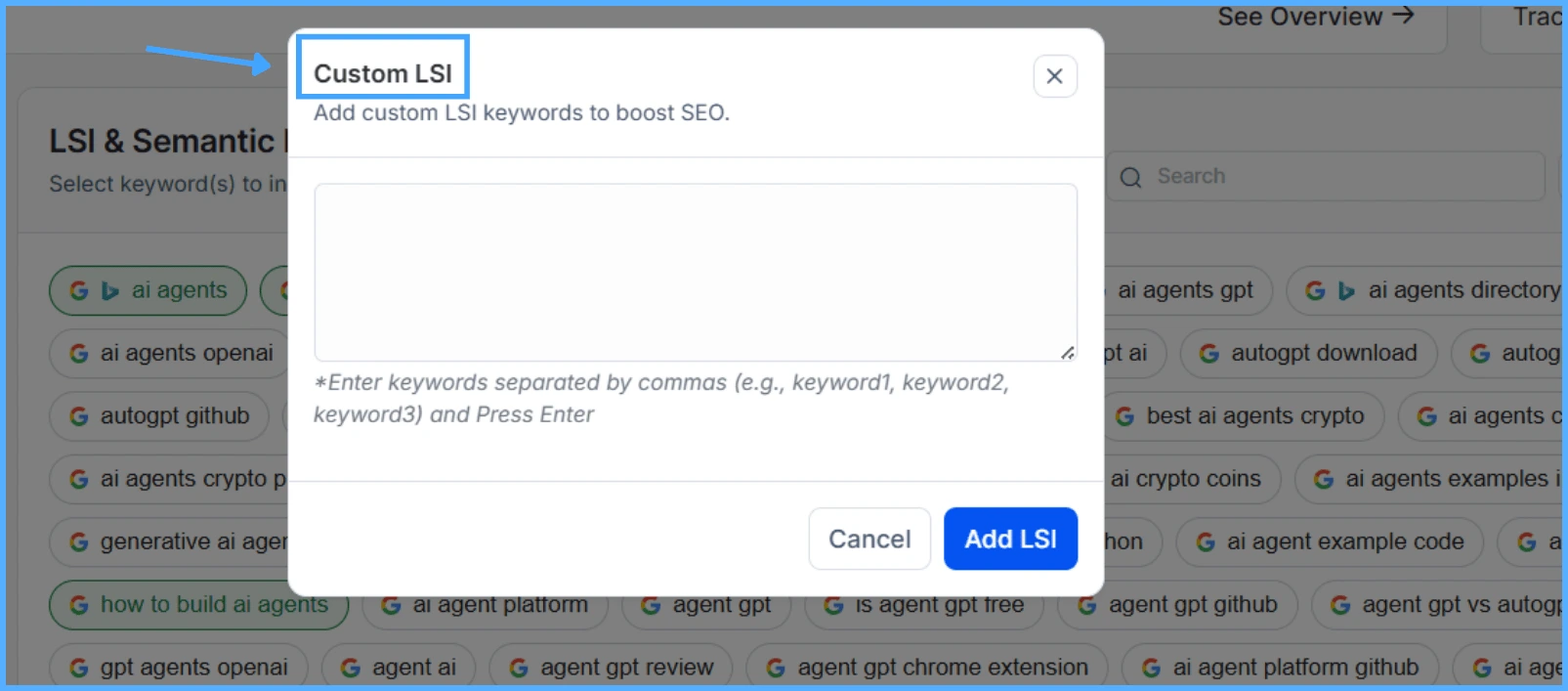
4. Add Custom LSI Terms
Manually enter additional LSI keywords that are relevant to your brand, niche, or content strategy.
5. Apply to Your Brief
Once finalized, your selected LSI keywords are added to your content brief to support structure and semantic intent from the start.
How Can Understanding LSI Principles Benefit SEO?
KIVA by Wellows automatically suggests semantically related phrases from Google and Bing. Unlike static keyword lists, these LSI signals expand coverage, strengthen briefs, and align content with LLMs like ChatGPT, Claude, Gemini, and DeepSeek—helping teams scale topical depth with less manual effort.
| SEO Principle | Without LSI Understanding | With LSI Principles (via KIVA) | Benefits |
|---|---|---|---|
| Enhanced Content Relevance & Comprehensiveness | Content remains narrow and keyword-focused | Incorporates semantically related terms and phrases | More comprehensive topical coverage, stronger context alignment |
| Improved User Experience | Thin content; limited exploration of related concepts | Expands into related ideas and supporting context | Engages readers longer, satisfies user intent |
| Avoidance Of Keyword Stuffing | Repetitive keyword usage dominates the content | Uses natural synonyms and semantically linked terms | Better readability, avoids penalties, smoother flow |
| Alignment With Modern Search Algorithms | Optimized only for exact matches | Matches semantic interpretation (BERT, MUM, LLMs) | Improved rankings and AI-driven visibility |
| Future-Proofing SEO Strategy | Content optimized for outdated ranking signals only | Semantic optimization adapts to AI-driven search | Keeps content aligned with evolving algorithms & LLMs |
KIVA’s LSI engine transforms keyword research into semantic intelligence—fully automated, fully scalable across SEO and LLM workflows.
KIVA Makes LSI Optimization Seamless Across All Teams
KIVA by Wellows is an AI SEO Agent with LSI (Latent Semantic Indexing), a feature that extracts semantic terms from Google and Bing to strengthen briefs and align content with ChatGPT, Claude, Gemini, and DeepSeek. Unlike static keyword lists, KIVA injects live semantic signals into your briefs—boosting topical depth, ranking power, and LLM visibility automatically.
1. Agencies: Scaling Semantic Targeting for Clients
Agencies managing multiple clients need briefs and content with reliable depth. KIVA auto-injects Google/Bing-derived LSI terms into every outline, structured for SEO goals and LLM patterns.
| The Challenges | How KIVA Helps |
|---|---|
| Missed Topic Opportunities: Teams overlook semantically rich terms. Time Burnout: Hours lost compiling expansions manually. |
LLM-Aware LSI Suggestions: Auto-adds semantic terms aligned with Claude, Gemini, and Google. One-Click Brief Depth: Outlines enriched with H2-ready LSI content. |
Agencies highligts smoother multi-client workflows and faster approvals with KIVA LSI.
Ready to move beyond keyword lists? See how the AI search visibility platform for agencies builds semantically rich strategies aligned with modern search models.
2. Startups: Build Richer Content Without Extra Research
Startups move fast, and research can’t slow them down. KIVA’s LSI engine expands coverage automatically, creating content that feels complete and is optimized for both SERPs and LLMs.
| The Challenges | How KIVA Helps |
|---|---|
| Thin Articles: Over-reliance on one keyword weakens coverage. Missed LLM Opportunities: Drafts fail to surface in AI results. |
Auto-LSI Mapping: Pulls semantically linked terms from live search and model training patterns. Prompt-Aware Structuring: Boosts visibility across DeepSeek, OpenAI, and Claude. |
Startups highlights faster early traction and reduced research cycles with automated LSI coverage.
Explore how KIVA within the AI Search Visibility Platform for Startups helps build richer, LSI-powered content →
3. Freelancers: Add Semantic Authority Without Tools Overload
Freelancers need to balance speed with authority—and switching between keyword tools, SERP analyzers, and editors only slows them down. KIVA solves that by surfacing contextually rich, semantically relevant terms automatically, so freelancers can craft deeper, AI-optimized drafts in less time. With the AI Search Visibility Platform for Freelancers, every brief becomes smarter, more authoritative, and ready for both search engines and LLMs.
| The Challenges | How KIVA Helps |
|---|---|
| Keyword Repetition: Risk of shallow or stuffed copy. Manual SEO Research: Too many tabs and tools slow execution. |
Built-In Semantic Signals: KIVA injects variations directly into briefs. LLM Optimized Flow: Structures content in the way AI models prefer—faster, cleaner drafts. |
Freelancers highlights less tool clutter and quicker delivery of authority-driven content.
See how KIVA helps Freelancers with LSI →
4. Marketing Consultants: Advise Smarter with Semantic Insights
Consultants are expected to provide strategy-level clarity. KIVA’s LSI-backed briefs give them semantic depth and model-aligned structures to present to clients with confidence.
| The Challenges | How KIVA Helps |
|---|---|
| Outdated Keyword Lists: Clients rely on static keyword docs. No LLM Integration: Content misses AI-ready search structures. |
Live LSI Enrichment: Uses fresh Google/Bing semantic signals. Model-Specific Patterns: Shapes outlines aligned with Claude, Gemini, and ChatGPT visibility. |
Consultants highlights clearer semantic strategies and stronger client confidence with AI-ready briefs.
Ready to move beyond static keyword docs? The AI search visibility platform for consultants delivers data-backed depth and semantic precision for stronger, insight-led recommendations.
What KIVA’s LSI Keyword Output Reveals
Deliver broader topical coverage with real semantic depth—based on actual user phrasing and search signals, not assumptions.
LSI in Action
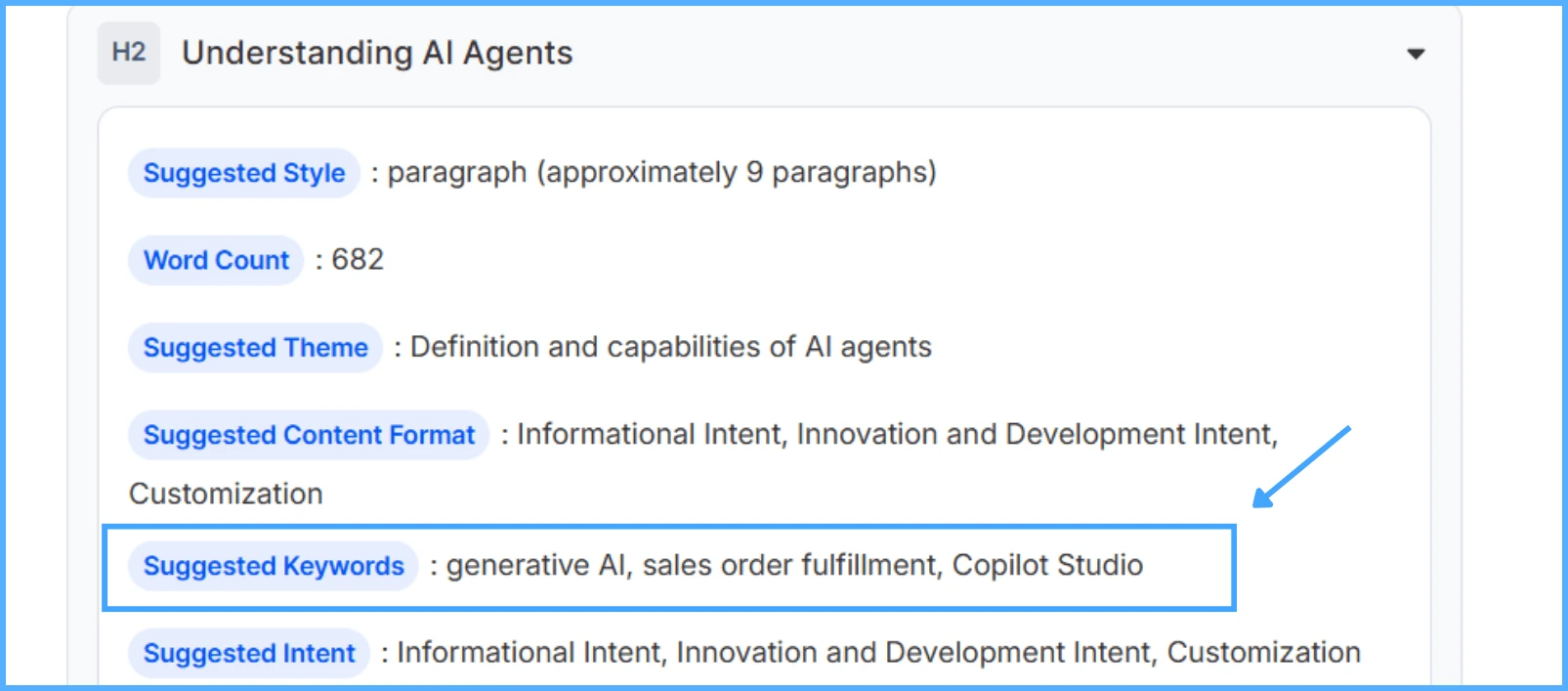
KIVA auto-generates LSI keyword variants that strengthen every layer of your content—from briefs to H2s to FAQs—using live Google and Bing semantic data.
- Automatic LSI Suggestions: Discover semantically linked phrases that expand your topic footprint.
- Google + Bing Context Signals: Pull directly from what real users type—not just assumptions.
- Enhanced Brief Structuring: Use LSI terms to build deeper sections, FAQs, and subheaders.
- Better Topic Matching: Improve how Google understands and ranks your content within broader topic clusters.
Explore Related Features That Power Semantic SEO
Use KIVA’s LSI system alongside other intelligence tools to enrich your SEO pipeline:
Helpful Tools to Maximize LSI Keyword Value
Sharpen every brief and outline using these semantic-focused tools:
- Keyword Research Checklist – Capture high-intent keywords plus long-tail and semantic variants across Google and AI models.
- LLM Pattern Recognition Checklist – Layer in formatting and tone patterns favored by LLMs to complement your LSI clusters.
These checklists enhance semantic structuring—helping your team align content with the way people actually search.
Recap: Why KIVA’s LSI Engine Improves Reach and Relevance
KIVA by Wellows is an AI SEO Agent that transforms keyword lists into semantic strategies by combining entity clustering, content brief generation, and SERP visibility analysis.
- Auto-discover keyword clusters, entity-rich terms, and phrase variations from Google and Bing
- Enrich content outlines with semantic expansions linked to LLMs like Claude, Gemini, and ChatGPT
- Boost topical authority and readability without keyword stuffing
- Embed deeper semantic signals across Brief Generator outputs, H2s, FAQs, and metadata
Because KIVA automates LSI mapping and semantic enrichment, your content gains broader visibility across search engines and AI-driven discovery.
FAQs
LSI principles improve content by adding semantic depth, reducing keyword stuffing, and aligning with algorithms like BERT and MUM. KIVA applies this automatically by pulling live semantic variants from Google and Bing into briefs and drafts, boosting both SEO and LLM visibility.
Tools like Google Auto Suggest, Ahrefs, and SEMrush reveal related terms. KIVA replaces manual research by using its LSI Engine to suggest live semantic clusters and entity-rich keywords directly inside the Brief Generator.
Keyword matching relies on exact terms, while LSI captures context and relationships. KIVA uses this to embed semantic signals into briefs, H2s, and metadata, improving SERP alignment and AI citation.
Yes—LSI is used in spam filtering, recommendation systems, and NLP. KIVA adapts this for marketing, turning entity clusters and semantic cues into SEO strategies and AI-aware content structures.
LSI struggles with polysemy, synonymy, and heavy computation. KIVA overcomes these by combining real-time SERP data with LSI principles, ensuring accurate keyword suggestions aligned with Gemini, Claude, and ChatGPT.